
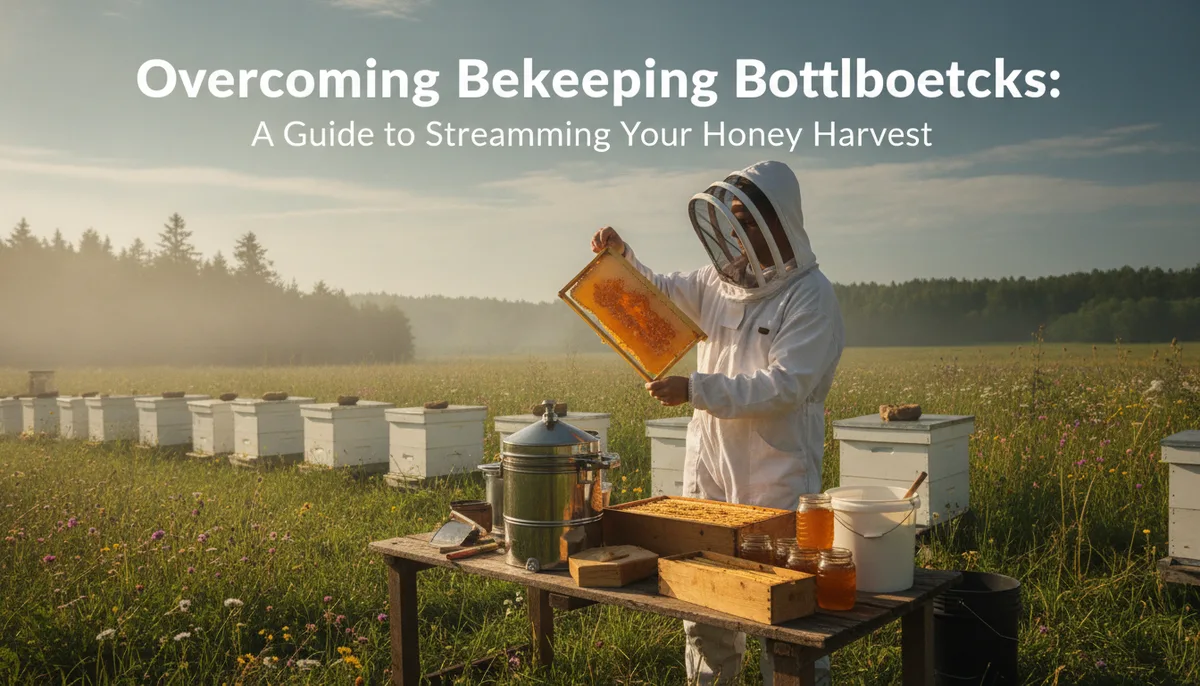
Overcoming Beekeeping Bottlenecks: A Guide to Streamlining Your Honey Harvest
The Reality of the Harvest Headache
Every beekeeper dreams of the "big year"—that perfect alignment of nectar flow, colony strength, and weather that results in supers stacked high with capped honey. However, as Stephen Bishop aptly noted, "Bottlenecks are the bane of a beekeeper’s existence." The moment you solve one problem, such as increasing your hive count or improving your mite management, a new bottleneck emerges in the honey house.
A bottleneck is a point of congestion in a production system that stops or slows the entire process. In beekeeping, this usually manifests during the harvest. You might have the fastest extractor on the market, but if you are still uncapping frames one by one with a manual scratcher, your expensive machinery is spending half its time spinning air.
To transition from a frustrated hobbyist to a successful sideliner, you must learn to identify these constraints and systematically eliminate them. This guide will walk you through the most common beekeeping bottlenecks and provide practical strategies for scaling your operation with confidence.
Identifying the Primary Constraint: The Uncapping Crisis
In the workflow of honey processing, the steps are generally: pull supers, uncap frames, extract, filter, and bottle. For the vast majority of beekeepers, the "uncapping station" is where the momentum dies.
The Evolution of Uncapping
Most beginners start with a simple beekeeping uncapping fork and a plastic tub. This is functional for two or three hives, but as you scale, the physical toll and the time required become unsustainable.
- Manual Knives and Scratchers: These are low-cost but high-labor. They require precision and patience.
- Electric Uncapping Knives: A significant step up, using heat to slice through wax like butter. However, they still require a human operator to handle every frame individually.
- Automated Uncappers: This is the "holy grail" for the growing apiary. Automated systems use vibrating blades or rotating chains to strip cappings from both sides of a frame in seconds.
If you find yourself saying, “It sure would be nice to have an automated uncapper,” you have officially identified your primary bottleneck. While the investment is significant, the time saved allows you to manage more hives or spend more time on colony health. For those just starting their journey and looking to avoid these early hurdles, exploring the Best Beginner Beekeeping Kits of 2024: Start Your Backyard Apiary with Confidence can help you set up a foundation that accounts for future growth.
Matching Your Extractor to Your Input
Once you solve the uncapping bottleneck, the pressure shifts immediately to the extractor. This is the "whack-a-mole" nature of beekeeping efficiency. If you invest in a high-speed automated uncapper but are still using a 2-frame manual honey extractor, you have simply moved the bottleneck three feet to the left.
Radial vs. Tangential Extractors
To maintain a steady flow, your extractor capacity must match your uncapping speed.
- Tangential Extractors: These require you to flip the frames to get honey out of both sides. They are generally slower and more labor-intensive.
- Radial Extractors: These spin frames with the top bar facing outward, using centrifugal force to pull honey from both sides simultaneously.
For a streamlined harvest, a motorized radial extractor is essential. It allows the beekeeper to load a batch of frames, start the motor, and return to the uncapping station to prepare the next load while the machine does the work. If you are currently evaluating your setup, our guide on the Best Honey Extractors for Small Scale Harvests: A Backyard Beekeeper’s Guide provides a deep dive into which models offer the best ROI for your specific hive count.
The Logistics of Flow: Sump Tanks and Pumps
The bottleneck often hides in the most literal sense—the flow of liquid honey. After the honey leaves the extractor, it needs to be filtered and moved into storage tanks.
The Gravity Problem
Many small-scale beekeepers rely on gravity, letting honey flow from the extractor gate into a 5-gallon bucket with a mesh sieve. This works until the sieve clogs with wax bits. At that point, the extractor must stop because there is nowhere for the honey to go.
The Professional Solution
To eliminate this, consider a heated stainless steel honey sump. A sump acts as a reservoir that catches the honey and uses a series of baffles to let wax rise to the top while clear honey is drawn from the bottom. When paired with a honey gear pump, you can move honey automatically from the sump to large settling tanks or bottling units. This creates a "continuous flow" system where the extractor never has to stop for a bucket change.
Beyond Hardware: Optimizing the Honey House Environment
Sometimes the bottleneck isn't a piece of machinery; it's the environment. Honey is a non-Newtonian fluid whose viscosity is highly dependent on temperature.
Temperature Control
If your honey house (or garage) is 60°F, your honey will move like molasses. This slows down extraction, increases the risk of frame blowouts in the extractor, and makes filtration nearly impossible.
- The Hot Room: Before extracting, store your honey supers in a small room or closet kept at 85-90°F for 24 hours. This warms the honey to hive temperature, making it significantly easier to uncap and extract.
- Workflow Layout: Arrange your equipment in a "U" or "L" shape. The frames should move in one direction: Uncapper -> Extractor -> Empty Super Storage. Minimizing the number of steps you take with a heavy frame reduces fatigue and increases throughput.
For those still navigating the first year, these logistical considerations might seem distant, but planning your space early can save you from costly renovations later.
Preparing for External Bottlenecks: The Future of the Apiary
While mechanical bottlenecks are within your control, biological bottlenecks are not. As you scale your operation and invest in high-end processing equipment, the health of your bees becomes even more critical to ensure you have a crop to process.
The beekeeping industry is currently bracing for new challenges that could severely bottleneck honey production at the source. For example, the potential arrival of new pests requires beekeepers to stay informed and proactive. Understanding threats like those discussed in Tropilaelaps Redux: Preparing for the Next Great Threat to American Beekeeping is essential for any beekeeper looking to protect their investment in equipment and livestock.
Conclusion: The Continuous Improvement Mindset
Eliminating bottlenecks is not a one-time event; it is a philosophy of management. As Stephen Bishop pointed out, the desire for automation is a natural response to the growth of an apiary. Whether you are adding your tenth hive or your hundredth, the goal is to spend less time fighting your equipment and more time managing your bees.
Start by auditing your next harvest. Where are you standing around waiting? Where is the mess most concentrated? By identifying these points of friction, you can make targeted investments—whether it's an automated uncapper, a better pump, or simply a space heater—that will turn your harvest from a bane into a triumph.
For a complete list of the gear that can help you move past the manual labor stage, check out our breakdown of Essential Beekeeping Tools Every Newbie Needs: Beyond the Hive and Suit.