
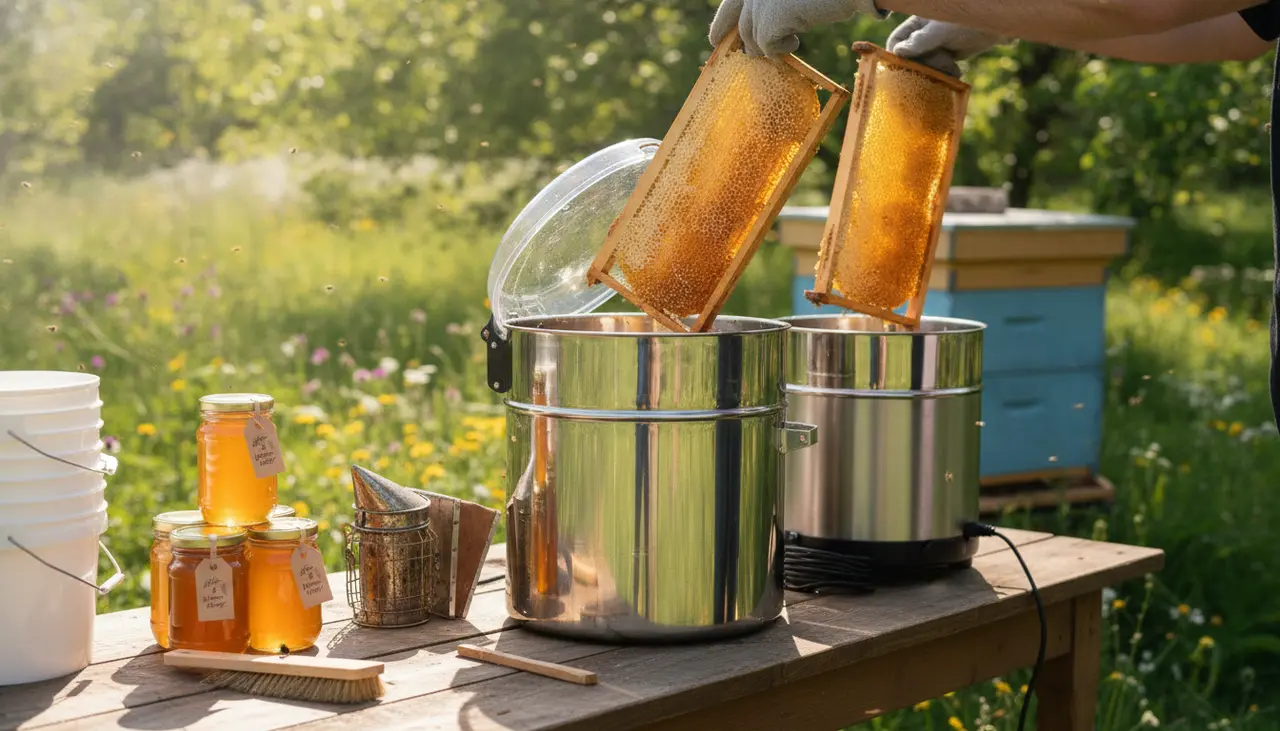
Best Honey Extractors for Small Scale Harvests: A Backyard Beekeeper’s Guide
Disclosure: This post contains affiliate links. If you click through and make a purchase, Hive & Honey may earn a small commission at no additional cost to you. We only recommend tools and gear that meet the needs of the hobbyist beekeeping community.
For the hobbyist beekeeper with 1 to 5 hives, a 2-frame or 3-frame manual tangential extractor is typically the best starting point. It offers a balance of affordability and compact storage, making it ideal for those just beginning their journey.
If you manage more than 5 hives or want to prioritize physical ease, a 4-frame electric radial extractor is the recommended upgrade. While the investment is higher, the ability to spin frames without manual cranking and without flipping them mid-cycle saves significant time during a busy harvest day.
The Sweet Reward: Choosing Your First Extractor
There is nothing quite like the smell of a honey house (or your kitchen) during the first harvest. After months of checking your brood boxes and monitoring for Varroa mites, seeing those honey supers filled with capped gold is a moment of pure joy. However, the transition from "bee guardian" to "honey producer" can feel a bit overwhelming.
This guide is designed for the backyard beekeeper who needs reliable equipment that won't break the bank or take up the entire garage. Whether you are navigating the first year or looking to upgrade from a "crush and strain" method, finding the right extractor is about matching the machine to your physical needs and your bees' productivity.
Comparison: Manual vs. Electric Extractors
| Feature | Manual Tangential Extractor | Electric Radial Extractor |
|---|---|---|
| Best For | 1-3 Hives, Budget-conscious | 5+ Hives, Physical ease |
| Frame Capacity | 2-4 Frames | 4-12+ Frames |
| Operation | Hand-cranked | Variable speed motor |
| Frame Flipping | Required (for tangential) | Not required (for radial) |
| Storage | Compact/Lightweight | Heavier/Requires power source |
| Price Point | Entry-level / Affordable | Mid-range to Premium |
Understanding the Mechanics: Tangential vs. Radial
Before diving into specific reviews, it’s helpful to understand how these machines actually work.
- Tangential Extractors: These spin the frames with one flat side facing the outer wall. You must spin one side, stop, flip the frame, and spin the other. They are highly efficient at getting every drop of honey out but require more "hands-on" time.
- Radial Extractors: Frames are loaded like spokes on a wheel. Centrifugal force pulls honey from both sides of the comb simultaneously. This is the gold standard for efficiency because you don't have to flip frames.
Best for the New Hobbyist: The 2-Frame Manual Extractor
If you are just starting out with a beginner beekeeping kit, a 2-frame manual extractor is your most likely companion.
Why we love it for beginners:
- Portability: These are usually light enough to move from the shed to the kitchen solo.
- Simplicity: With fewer moving parts, there is very little that can go wrong.
- Connection: There is something incredibly rewarding about feeling the weight of the honey as you crank the handle.
Considerations:
- The "Workout" Factor: Cranking for two hours can be tiring. If you have any shoulder or back concerns, the manual route might be a challenge.
- Flipping Frames: You will need to stop and flip each frame to get the honey out of both sides.
Best for Growing Apiaries: The 4-Frame Electric Extractor
As your apiary grows to 5 or 10 hives, the manual crank can become a bottleneck. An electric model allows you to uncap the next set of frames while the current batch is spinning.
Why it’s a game-changer:
- Efficiency: Most electric models for small-scale use are radial, meaning no flipping is required.
- Consistency: Variable speed motors allow you to start slow (to prevent comb blowout) and speed up gradually.
- Multi-tasking: You can focus on your uncapping tools and prep the next batch while the machine does the heavy lifting.
Considerations:
- Power Access: You’ll need to set up near an outlet, which might limit where you can harvest.
- Cleaning: Motors and wires mean you have to be a bit more careful during the post-harvest wash-down.
Essential Harvesting Tools to Pair with Your Extractor
An extractor is the star of the show, but it can’t work alone. To make your harvest go smoothly, ensure you have these nearby:
- Uncapping Knife or Fork: To remove the wax cappings so the honey can escape.
- Uncapping Tank: A place to catch the wax and let the initial honey drip through a strainer.
- Honey Sieve/Strainer: Usually a dual-stage stainless steel mesh that sits over your bottling bucket.
- Bottling Bucket with Honey Gate: This makes the final step of putting honey into jars much cleaner.
Common Beginner Extraction Mistakes
- Spinning Too Fast, Too Early: If you start at high speed, the weight of the honey can blow out your delicate beeswax foundation. Start slow!
- Extracting "Wet" Honey: Always ensure your frames are at least 80% capped. Uncapped honey has higher moisture content and can ferment in the jar.
- Forgetting the Honey Gate: Always make sure the gate at the bottom of the extractor is closed before you start—or that there is a bucket underneath it! We've all made the "honey floor" mistake once.
- Cold Extraction: Honey flows best when it’s warm. If you’ve pulled your supers and let them sit in a cold garage overnight, the extraction will be much slower.
Frequently Asked Questions
How do I clean my extractor? The best way is with cold or lukewarm water first (to avoid melting wax into the gears), followed by warm soapy water. Rinse thoroughly and let it air dry completely before storing to prevent rust.
Can I use a manual extractor for a Flow Hive? Flow Hives are designed to be harvested in the hive without an extractor. However, if you have traditional Langstroth frames alongside your Flow frames, you will still need an extractor for those.
Is stainless steel better than plastic? Yes. For food safety and durability, food-grade stainless steel is the industry standard. Plastic extractors can be cheaper but tend to be less stable and harder to clean over time.
How much honey will I get? On average, a full deep Langstroth frame can hold about 6-8 pounds of honey, while a medium "honey super" frame holds about 3-4 pounds. A 2-frame extractor can process about 8-10 pounds of honey per load.
Final Thoughts
Choosing an extractor is an investment in your future as a beekeeper. While it might seem like a large purchase, a well-maintained stainless steel extractor can last for decades. Start with what fits your current hive count, but don't be afraid to size up if you plan on expanding your backyard apiary next spring!