
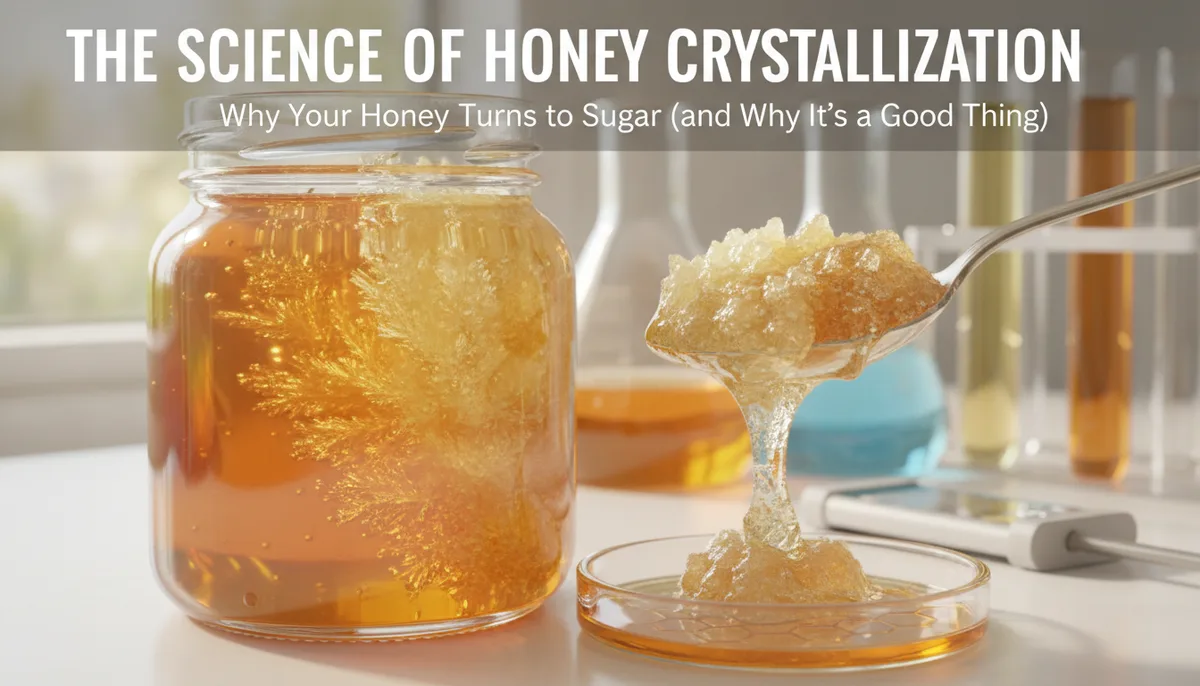
The Science of Honey Crystallization: Why Your Honey Turns to Sugar (and Why It’s a Good Thing)
In the early days of Two Hives Honey, founder Tara Chapman stood behind a simple card table at a large Texas bee school. She had a black tablecloth and a few dozen jars of honey—vessels she had carefully chosen to showcase her most prized possession. To her surprise, many attendees looked at her jars of thick, opaque, "sugary" honey with skepticism. Some even suggested the honey had "gone bad" or that she had added sugar to the jars.
This experience is common among beekeepers and honey enthusiasts alike. There is a persistent myth that honey should always be a clear, golden liquid. When it begins to cloud or turn solid, consumers often assume it has expired. However, the reality is exactly the opposite. Crystallization is a natural, scientific phenomenon that serves as a hallmark of raw, high-quality honey.
Understanding the science behind this process not only helps you appreciate the complexity of what bees produce but also ensures you don't waste a perfectly good jar of liquid gold.
The Chemistry of a Supersaturated Solution
To understand why honey crystallizes, we first have to look at its chemical composition. Honey is essentially a "supersaturated" solution. In chemistry, a solution is supersaturated when it contains more dissolved material than the liquid can theoretically hold under normal conditions.
Honey is composed of approximately 70% to 80% sugar and about 18% water. The two primary sugars found in honey are glucose and fructose. Because there is so much sugar relative to the water content, the solution is unstable. Eventually, the excess sugar—specifically the glucose—wants to separate from the water and return to its natural crystalline state.
Glucose vs. Fructose: The Balancing Act
The speed at which your honey turns to "sugar" depends almost entirely on the ratio of glucose to fructose.
- Glucose: This sugar is less soluble than fructose. When glucose loses its water molecules, it precipitates out of the solution and forms crystals.
- Fructose: This sugar is highly soluble and stays liquid much longer.
Every floral source provides a different nectar composition. For example, honey derived from Alfalfa, Cotton, or Dandelion has a very high glucose-to-fructose ratio and may crystallize within weeks of being harvested. Conversely, honey from Tupelo, Sage, or Black Locust trees is naturally high in fructose and can remain liquid for years without any intervention.
The Role of "Seeds" in the Crystallization Process
Honey doesn't just spontaneously turn solid; it usually needs a "seed" or a nucleus to start the chain reaction. In the world of raw honey, these seeds are everywhere.
When honey is kept in its raw state, it contains microscopic particles including:
- Pollen grains
- Tiny bits of beeswax
- Propolis
- Dust or air bubbles
These particles act as a scaffolding for glucose crystals to latch onto. Once a few crystals form around a grain of pollen, they trigger a "domino effect," encouraging other glucose molecules to join in. This is why raw honey crystallizes much faster than the honey you find in a typical plastic bear at the grocery store.
If you are a beekeeper managing your own harvests, using high-quality equipment can help you control the clarity and purity of your final product. For those looking to refine their process, check out our guide on the Best Honey Extractors for Small Scale Harvests: A Backyard Beekeeper’s Guide.
Why Grocery Store Honey Stays Liquid
If crystallization is so natural, why is the honey on supermarket shelves always perfectly clear? The answer lies in industrial processing. Most commercial honey producers use two main methods to prevent crystallization:
- Ultra-Filtration: Commercial honey is often heated and forced through extremely fine filters at high pressure. This removes all the "seeds"—the pollen and wax—that would otherwise trigger crystallization. While this keeps the honey liquid, it also removes the beneficial pollen and nutrients that make honey a "superfood."
- Pasteurization: By heating honey to very high temperatures (often 160°F or higher), producers dissolve any existing micro-crystals. However, this high heat also destroys the delicate enzymes and floral aromas that give raw honey its unique flavor profile.
When you buy raw honey that eventually crystallizes, you are seeing proof that the honey still contains its natural pollen and has not been stripped of its biological value.
Temperature: The "Sweet Spot" for Crystals
Environmental factors play a massive role in how quickly your honey changes texture. Honey stored in a cold pantry or a refrigerator will crystallize much faster than honey stored in a warm kitchen.
The "sweet spot" for crystallization is between 50°F and 60°F (10°C - 15°C). At these temperatures, the glucose molecules move slowly enough to bond together but have enough energy to form organized structures. If you store your honey in a location that stays consistently in this range, you can expect it to solidify rapidly.
Conversely, honey stored at temperatures above 77°F (25°C) resists crystallization, and very low temperatures (like a freezer) actually stop the process because the liquid becomes too viscous for the molecules to move and form crystals.
For new beekeepers, managing the environment of your honey room is just as important as managing the hive itself. If you're just starting out, ensure you have the Essential Beekeeping Tools Every Newbie Needs: Beyond the Hive and Suit to handle your harvest correctly.
How to Decrystallize Honey Without Ruining It
If you prefer your honey in a liquid state, there is no need to throw away a crystallized jar. You can "reliquefy" it with a little bit of patience and gentle heat. The key word here is gentle.
The Warm Water Bath Method
- Place your glass jar of honey into a bowl or pot of warm water.
- The water should be around 95°F to 110°F. This mimics the natural temperature of a beehive.
- Let the jar sit until the crystals dissolve, stirring occasionally to distribute the heat.
- Avoid using boiling water, as this can "cook" the honey and degrade its quality.
digital infrared thermometer for honey temperature
What to Avoid
- The Microwave: Never microwave your honey. Microwaves create "hot spots" that can easily exceed 160°F in seconds, destroying the enzymes and potentially scorching the sugars.
- Plastic Containers: If your honey is in a plastic squeeze bottle, it is best to transfer it to a glass jar before heating, as plastics can leach chemicals when warmed.
Embracing the Texture: Creamed Honey
Rather than fighting the crystallization process, many honey connoisseurs choose to embrace it. In many parts of the world, "creamed honey" (also known as whipped honey or spun honey) is the preferred way to consume this sweetener.
Creamed honey is made by controlling the crystallization process. By introducing a "starter" of very fine crystals and keeping the honey at a specific cool temperature, beekeepers can create a product with a smooth, buttery consistency. It has the same nutritional benefits as liquid raw honey but is much easier to spread on toast without the mess.
If you are transitioning from a hobbyist to a more serious honey producer, learning the art of creamed honey is a fantastic way to add value to your harvest. This is one of the many skills you'll encounter as you move past the basics. For more on that journey, see our guide on Navigating the First Year: A Comprehensive Guide to Transitioning from Neophyte to Confident Beekeeper.
Conclusion: A Mark of Authenticity
The next time you reach for a jar of honey and find it has turned into a solid, sugary mass, don't be disappointed. Instead, take it as a sign of authenticity. Crystallization is the honey's way of proving it is raw, unadulterated, and full of the natural pollens and enzymes that the bees intended.
Whether you choose to gently warm it back into a liquid or enjoy the rich, spreadable texture of the crystals, you are consuming one of nature's most stable and incredible foods. Honey is the only food that truly lasts forever; crystallization is simply a chapter in its long, sweet story.
electric honey warming belt for decrystallizing