
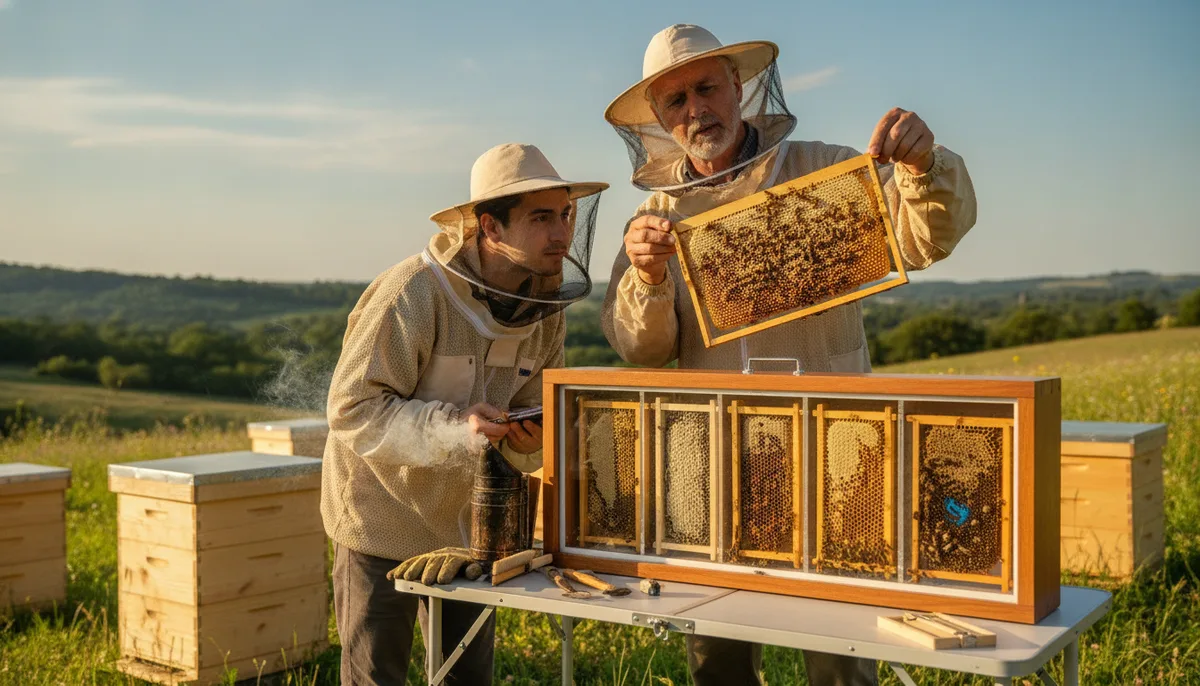
The Five-Frame Learning Box: Fast-Tracking Your Journey to Beekeeping Mastery
The transition from an aspiring enthusiast to a capable beekeeper is often marked by a period of intense "information overload." You may have spent dozens of hours reading manuals, attending local association meetings, and scrolling through digital tutorials. Yet, the moment you stand before a buzzing hive with a smoker in hand, the gap between theory and practice can feel like a chasm.
As noted beekeeping expert David Burns suggests, you cannot become a proficient beekeeper through passive consumption alone. True expertise is forged in the apiary, through the heat of the sun, the smell of propolis, and the tactile feedback of a hive tool against a frame. To bridge this gap, many experts recommend the use of a "five-frame learning box"—a scaled-down nucleus colony designed specifically to accelerate the learning curve.
The Theory-Practice Gap in Modern Beekeeping
In the digital age, we have more access to beekeeping information than any generation before us. However, this abundance of data often creates a false sense of security. A beginner might understand the 21-day lifecycle of a worker bee intellectually, but recognizing the subtle difference between a three-day-old larva and a four-day-old larva under direct sunlight is a physical skill that requires repetition.
The "learning box" approach addresses the psychological hurdle of the first year. A full 10-frame deep box, heavy with honey and teeming with 40,000 bees, can be intimidating. When a novice is overwhelmed, they tend to rush through inspections, missing the vital signs of hive health. By starting with a smaller, more manageable population, you can slow down and focus on the nuances of bee behavior.
For those just starting, Navigating the First Year: A Comprehensive Guide to Transitioning from Neophyte to Confident Beekeeper provides a roadmap for this emotional and technical journey.
Why Five Frames? The Philosophy of the Nucleus Hive
A five-frame nucleus hive, or "nuc," is more than just a small box; it is a biological snapshot of a healthy colony. Because the space is confined, the bees’ activities are concentrated. For a student of the craft, this concentration is an advantage.
Ease of Observation
In a standard hive, finding the queen can feel like looking for a needle in a haystack. In a five-frame learning box, your search area is cut in half. This allows you to practice "queen spotting" with a much higher success rate, which in turn builds the confidence needed to manage larger colonies later.
Rapid Feedback Loops
In a small hive, changes happen quickly. You can see how a nectar flow impacts comb building across just a few frames within days. You can observe the queen’s laying pattern with greater clarity. This rapid feedback is essential for the "fast track" experience. You aren't just looking at bees; you are learning to read the frame like a story.
If you are looking to set up your first educational colony, selecting the right equipment is the first step.
Mastering the Visual Language of the Hive
To use a learning box effectively, you must train your eyes to see what is often invisible to the untrained observer. The goal is to move beyond "Are there bees?" to "What are the bees doing?"
Identifying Brood Stages
The primary mission of your learning box inspections should be identifying the various stages of brood.
- Eggs: These look like tiny grains of rice at the bottom of the cell. Seeing eggs confirms the queen was present at least three days ago.
- Larvae: Look for the "C" shape. Healthy larvae should be pearly white and sitting in a pool of royal jelly.
- Capped Brood: This should be uniform and tan. Spotty brood patterns in a small nuc are an early warning sign of queen failure or disease—lessons that are vital to learn early on.
Understanding Resource Placement
A learning box teaches you the "geography" of a hive. Typically, bees place brood in the center, flanked by pollen (the protein), and then honey (the carbohydrate) on the outer edges. Understanding this layout in a five-frame setup makes it much easier to organize a larger 10-frame or 8-frame hive for optimal winter survival.
To assist with these close-up observations, a high-quality magnifying tool can be an invaluable asset for the aging eye or the detail-oriented student.
Moving Beyond Observation: Taking Action
Once you are comfortable observing the hive, the learning box becomes a system envelope for management techniques. One of the most critical skills a beekeeper can learn is how to manage space.
In a five-frame hive, the bees will run out of room quickly. This provides a "low-stakes" environment to practice:
- Checkerboarding: Adding empty frames to prevent swarming.
- Queen Marking: If you can find the queen easily in a nuc, you can practice the delicate art of marking her with a non-toxic pen.
- Splitting: Learning how to take a frame of bees and brood to start a new colony.
While you practice these skills, remember that environmental factors play a huge role in how bees react to your interventions. For more on this, see Weather to Fly: Understanding Meteorological Impacts on Honey Bee Activity.
Essential Tools for the Hands-On Learner
While the bees do the heavy lifting, your success as a student depends on having the right tools to facilitate your education. You don't need a shed full of gadgets, but you do need "intentional" tools.
Beyond the standard suit and smoker, consider the following for your learning box:
- A Frame Perch: This hooks onto the side of the hive and holds frames you’ve removed. In a 5-frame box, space is tight; having a perch prevents you from accidentally crushing the queen when you set a frame down.
- A Fine-Tipped Hive Tool: Precision matters when you are trying to lift frames without rolling bees.
- A Logbook: Experience is only valuable if you remember it. Documenting what you saw in your five-frame box every week allows you to track the colony's development and your own progress.
For a deeper dive into the gear that actually matters, check out Essential Beekeeping Tools Every Newbie Needs: Beyond the Hive and Suit.
The Path to Confidence
The ultimate goal of the five-frame learning box is to graduate. Eventually, your nuc will become too crowded, and you will need to "step it up" into a full-sized hive body. By the time this happens, you won't be a nervous beginner anymore. You will have seen the queen, identified the brood, managed the space, and perhaps even dealt with a minor pest issue like wax moths or mites.
This hands-on experience transforms "book knowledge" into "beekeeper's intuition." You begin to recognize the sound of a queenless hive or the specific scent of a heavy nectar flow. These are things that no YouTube video can truly convey.
If you are ready to make the leap and want to ensure you have everything required for a successful start, our review of the Best Beginner Beekeeping Kits of 2024: Start Your Backyard Apiary with Confidence can help you choose the right foundation for your apiary.
Conclusion: Embodying the Craft
Beekeeping is an ancient dialogue between humans and one of nature's most complex social organisms. While the science of the hive is fascinating, the art of the hive is found in the doing. By dedicating a small portion of your apiary to a "learning box," you give yourself permission to be a student. You allow yourself the space to make mistakes, to look closer, and to move slower.
In the words of David Burns, "Good beekeepers are made from gaining experience." Don't just read about the bees this season—get into the box, observe the lifecycle, and let the bees themselves be your primary instructors. The fast track to mastery isn't found in a library; it's found in the five frames sitting in your backyard.