
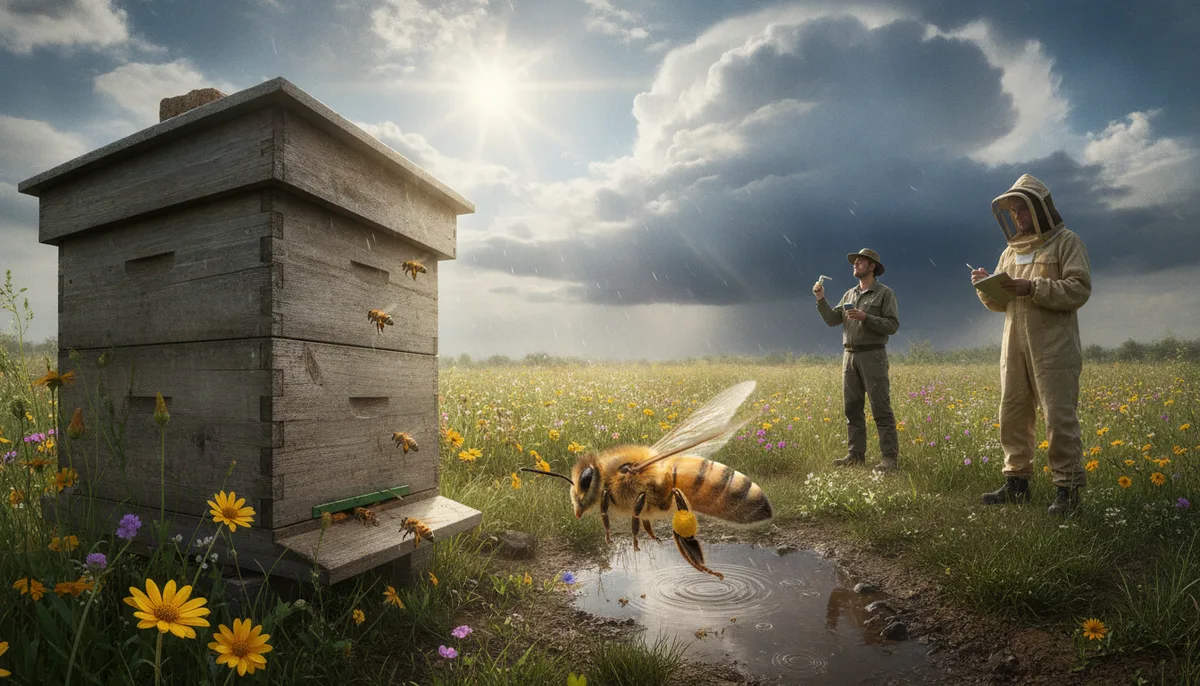
Weather to Fly: Understanding Meteorological Impacts on Honey Bee Activity
Long before I began keeping bees in the lush, often damp landscapes of Washington, a retired couple lived down the road from me. They were the local authorities on all things apian—people known well to the community, who kept a simple, hand-painted sign tacked to a cedar tree in their front yard: Honey for Sale. He was a hard-working but taciturn man, often found in the workshop or tending the back 40; she was the equally industrious but far more talkative counterpart who managed the sales and the stories.
Whenever I visited, the conversation eventually turned to the sky. In the Pacific Northwest, "weather to fly" isn't just a casual observation; it is the metric by which the entire season is measured. To the uninitiated, a bee is simply a creature that flies when it is sunny. To the beekeeper, the flight of a bee is a complex calculation involving thermal thresholds, wind resistance, and barometric sensitivity.
Understanding these meteorological nuances is a hallmark of navigating the first year as a beekeeper, transitioning from a hobbyist who watches the hive to a steward who understands the colony’s rhythm.
The Thermal Threshold: Why 50°F is the Magic Number
The most fundamental constraint on honey bee flight is temperature. Honey bees are ectothermic (cold-blooded) in the sense that they rely on environmental heat to maintain flight muscle function, yet they are remarkably capable of generating internal heat through isometric contraction of those same muscles.
However, there is a hard limit. When the ambient air temperature drops below 50°F (10°C), the honey bee’s ability to maintain its thoracic temperature—required to be around 80°F to 95°F for flight—becomes increasingly difficult. If a bee lands on a cold surface or stays out too long in sub-50°F weather, its muscles may "chill," leaving it unable to take off again. This is why you will often see bees "grounded" on sidewalks or flowers during a sudden spring cold snap.
The Dynamics of the "Cleansing Flight"
Even in the dead of winter, a brief spike in temperature can trigger a flurry of activity. These are known as cleansing flights. Bees are exceptionally hygienic and will refuse to defecate inside the hive unless they are suffering from severe dysentery or are trapped by weeks of freezing weather.
When the thermometer hits that 50°F mark on a sunny February afternoon, the colony takes the opportunity to "clean house." For the beekeeper, seeing these flights is a sign of a healthy, surviving colony. For more on how bees manage their internal hive environment during these cold months, understanding the science of the solid can provide deeper insight into their winter survival strategies.
The Impact of Wind and Turbulence on Foraging Efficiency
Temperature tells the bee if it can fly; wind tells the bee how far it can go. A honey bee’s cruising speed is approximately 15 to 20 miles per hour. When head-winds match or exceed this speed, the energy expenditure required to reach a nectar source becomes unsustainable.
The Energy Cost of Navigation
Bees are masters of fuel management. They leave the hive with just enough honey stores to reach their destination. If a sudden wind picks up, a bee may run out of "fuel" before it can return home. Furthermore, high winds make the actual act of landing on a swaying flower incredibly difficult.
Beekeepers should monitor local wind patterns. If your apiary is in a particularly gusty corridor, consider installing windbreaks. A simple lattice fence or a hedge can create a "micro-climate" of calm air, allowing bees to exit and enter the hive without being tossed against the landing board.
To accurately track the conditions in your specific yard, many veterans recommend using a to check wind speeds before deciding whether to perform a full hive inspection.
Rain, Humidity, and the Risk of "Water Logging"
While a light mist might not deter the most ambitious foragers, rain is generally a "no-fly" condition. Raindrops are heavy relative to a bee’s body mass, and a direct hit can knock a bee out of the air or damage its delicate wings.
Humidity and Nectar Concentration
Beyond the physical danger of rain, humidity plays a subtle role in foraging. High humidity can prevent nectar from dehydrating, which sounds beneficial, but it also means the bees have to work harder inside the hive to evaporate moisture from the stored nectar to turn it into honey. Conversely, very dry, hot winds can dry up nectar in the flowers entirely, leading to a "dearth" even in the middle of a bloom.
Bees are also sensitive to barometric pressure. They can sense a storm front moving in long before the first drop of rain falls. You may notice an "entrance rush" where hundreds of bees return to the hive simultaneously as the sky darkens—this is the colony’s collective response to a falling barometer.
Light Intensity and the "Polarized Sky"
Bees do not see the world as we do. They rely on ultraviolet light and the polarization of sunlight to navigate, even on cloudy days. However, light intensity still dictates the "working hours" of the hive.
- Dawn and Dusk: Foraging usually begins shortly after sunrise when the light is sufficient for navigation and the morning dew begins to evaporate. It tapers off as the sun sets.
- Solar Eclipses and Heavy Overcast: During a solar eclipse or exceptionally dark storm clouds, bees will often return to the hive, tricked into thinking night has fallen.
For the beekeeper, light is a tool. When performing inspections, a bright, sunny day between 10:00 AM and 2:00 PM is ideal. This is when the majority of the older, more "defensive" foragers are out in the fields, leaving the younger, gentler nurse bees behind in the hive.
Monitoring Weather: Tools for the Modern Apiary
In the days of the retired couple down the road, weather monitoring consisted of a look at the clouds and a finger in the wind. Today, we have access to precision tools that can help us make better management decisions.
Remote Hive Monitoring
Modern technology allows beekeepers to monitor the internal and external conditions of the hive without ever opening the lid.
- Internal Sensors: Track the brood nest temperature. A steady 95°F indicates the queen is laying and the colony is active.
- External Weather Stations: Knowing the exact temperature and wind speed at your apiary—which may be miles from the nearest official weather station—is invaluable.
If you are looking to upgrade your setup, a can provide real-time data to your smartphone, helping you decide if today is a "weather to fly" day or a day to stay inside and prep equipment.
Additionally, for those managing multiple hives, a can tell you if the bees are actually bringing in nectar (weight gain) or consuming stores (weight loss) during specific weather patterns.
The Beekeeper's Intuition: Learning to Read the Sky
Ultimately, no tool can replace the "taciturn man’s" intuition—the ability to step outside, feel the dampness in the air, and know exactly how the bees will behave.
If the air is heavy and still, expect the bees to be "moody" or "cranky." This is often referred to as "thunderstorm weather" in beekeeping circles. The bees feel the pressure, they aren't out foraging, and they are more likely to defend the hive vigorously. Conversely, a clear day with a light breeze and a temperature of 75°F usually results in a calm, productive colony that is a joy to work with.
As you grow in your practice, you will find that you stop checking the weather app for your own comfort and start checking it for theirs. You’ll learn that "weather to fly" is a window of opportunity—a fleeting alignment of sun, wind, and warmth that allows the miracle of pollination and honey production to continue.
Whether you are just starting with the best beginner beekeeping kits of 2024 or you have been tending hives for decades, the sky remains your most important mentor. Respect the limits of the bee, and they will reward you with a flourishing apiary and a harvest that tastes of the very sunshine they chased.