
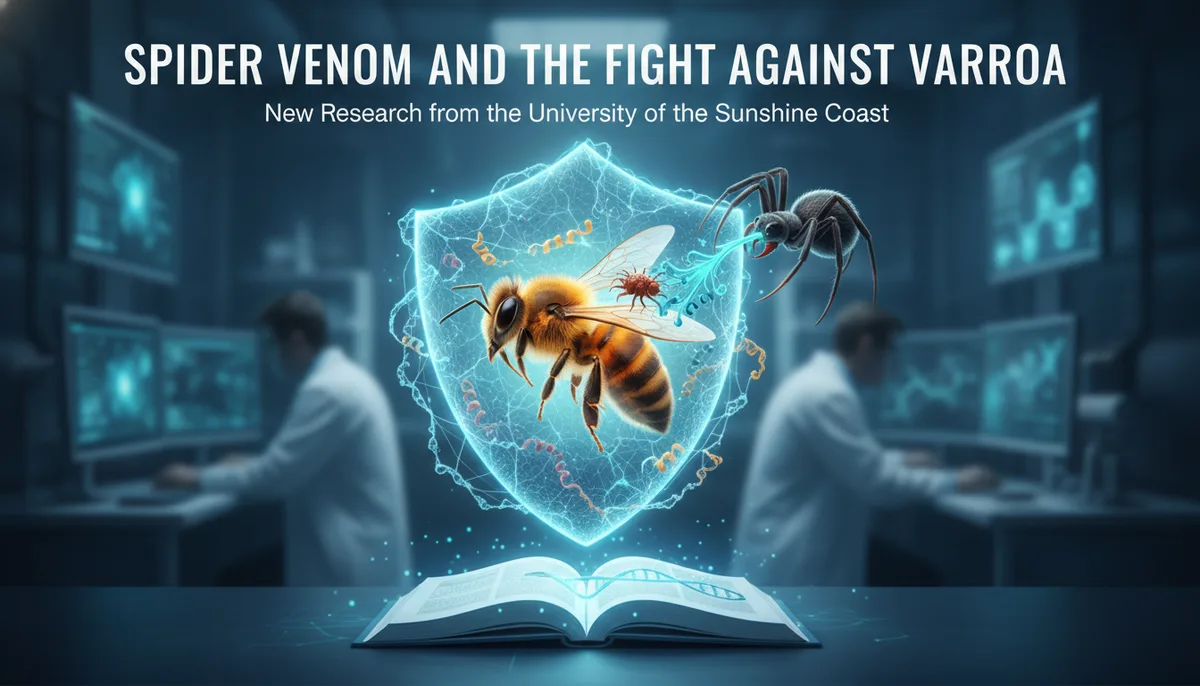
Spider Venom and the Fight Against Varroa: New Research from the University of the Sunshine Coast
The battle against Varroa destructor has reached a critical juncture. For decades, beekeepers have relied on a dwindling arsenal of synthetic chemicals and organic acids to keep mite populations below the economic injury level. However, as we move through 2026, the limitations of these treatments have become increasingly apparent. Resistance to common acaricides is rising, and the demand for "cleaner" hive products is at an all-time high.
Recent news, highlighted by the American Bee Journal and researcher Ray Johnson, points toward a fascinating and perhaps unexpected ally in this fight: the Tasmanian cave spider (Hickmania troglodytes). Scientists at the University of the Sunshine Coast in Australia are currently exploring how the complex venom of this ancient arachnid could be synthesized into a targeted weapon against Varroa mites.
The Evolutionary Arms Race: Why Spider Venom?
Spiders are the world’s most prolific hunters of insects and other arachnids. Over millions of years, they have evolved a "chemical cocktail" of toxins designed to immobilize prey almost instantly. What makes spider venom particularly interesting to agricultural scientists is its specificity.
Venom is not a single substance; it is a mixture of hundreds of different proteins and peptides. Some of these peptides are generalists, affecting a wide range of organisms, while others are highly specialized. The goal of the research at the University of the Sunshine Coast is to identify "mite-specific" toxins—compounds that disrupt the nervous system of the Varroa mite but leave the honey bee completely unharmed.
This level of precision is the "holy grail" of pest management. Unlike broad-spectrum treatments that can stress the colony or contaminate wax, a peptide-based bio-acaricide derived from spider venom could offer a surgical strike against the parasite.
The Tasmanian Cave Spider: A Unique Genetic Resource
The Tasmanian cave spider is one of the most primitive spiders on earth. Found only in the cool, dark cave systems of Tasmania, this species has remained relatively unchanged for millions of years. Because of its unique evolutionary lineage, its venom contains molecular structures that differ significantly from the "modern" spiders we encounter in our gardens.
By studying the venom of Hickmania troglodytes, Australian researchers have uncovered peptides that appear to target specific ion channels in the nervous systems of mites. Because mites and bees belong to different biological classes (Arachnida vs. Insecta), there are subtle differences in their neurology. The University of the Sunshine Coast team is leveraging these differences to ensure the venom-based treatment is a "bio-rational" pesticide—one that is inherently safe for the non-target host.
Moving Beyond Synthetic Resistance
The urgency of this research cannot be overstated. For years, the beekeeping industry has leaned heavily on Amitraz-based products. While effective, reports of "creeping resistance" have become common in commercial operations across the United States and Europe. When a mite population develops resistance to a chemical, the beekeeper is forced to increase dosages or frequency, leading to higher costs and potential risks to bee health.
The introduction of a spider-venom-based treatment would introduce an entirely new "mode of action." In Integrated Pest Management (IPM), rotating treatments with different modes of action is the primary strategy for preventing resistance. If we can alternate between organic acids and peptide-based toxins, we can extend the lifespan of all available treatments.
While we wait for these advanced biological controls to hit the market, beekeepers must remain vigilant with current monitoring techniques.
Accurate monitoring is the first step in any IPM plan. For those interested in the broader landscape of emerging threats, it is worth noting that Varroa is not our only concern; the industry is also preparing for other invasive parasites. For more on this, see our guide on Tropilaelaps Redux: Preparing for the Next Great Threat to American Beekeeping.
Safety and Environmental Impact
One of the most significant advantages of peptide-based pesticides is their environmental profile. Unlike many synthetic chemicals that persist in the environment or accumulate in hive wax, peptides are proteins. When they are exposed to the environment, they eventually break down into harmless amino acids.
This means that a spider-venom-derived treatment could potentially be used during a honey flow without the risk of tainting the harvest. For the consumer, this translates to honey that is free from synthetic residues. For the beekeeper, it means less time worrying about "withdrawal periods" and more time focusing on colony productivity.
Furthermore, because these peptides are targeted, they pose minimal risk to other beneficial insects in the environment, such as native pollinators or predatory beetles that may live near the apiary.
Integrating New Technology with Traditional Husbandry
While the prospect of "spider venom in a bottle" is exciting, it is unlikely to be a "silver bullet" that eliminates the need for good husbandry. The most successful beekeepers are those who combine cutting-edge science with foundational skills.
New beekeepers, in particular, should focus on mastering the basics of hive health before relying solely on the latest chemical breakthroughs. Understanding the lifecycle of the bee and the mite is essential for timing any treatment, whether it is a traditional organic acid or a futuristic peptide.
If you are just starting your journey, ensuring you have the right gear is paramount. Check out our list of Essential Beekeeping Tools Every Newbie Needs: Beyond the Hive and Suit to ensure you are prepared for the season.
The Road to Commercialization: What to Expect
Research from the University of the Sunshine Coast is a vital first step, but the road from the laboratory to the local bee supply shop is long. The development process involves several key stages:
- Peptide Isolation: Identifying the specific molecules that kill mites.
- Synthesis: Finding a way to "manufacture" these peptides in a lab so we don't have to milk thousands of cave spiders.
- Field Trials: Testing the synthesized compound in real-world hives to ensure it works in different climates and hive configurations.
- Regulatory Approval: Meeting the stringent safety standards set by organizations like the EPA in the United States or the APVMA in Australia.
As of late 2026, the research is showing great promise in the laboratory and controlled flight cage settings. The next few years will be telling as researchers move into larger-scale field trials.
Conclusion: A New Era of Biopesticides
The study of Tasmanian cave spider venom represents a shift in how we approach honey bee health. We are moving away from "brute force" chemistry and toward "intelligent" biological solutions. By looking at the natural world—specifically the ancient relationship between spiders and their prey—we are finding the keys to protecting our most important pollinators.
For the modern beekeeper, staying informed about these developments is part of the job. While we may still be using alcohol washes and oxalic acid today, the future of the apiary looks to be increasingly high-tech and bio-focused.
To stay ahead of the curve and ensure your colonies are thriving, consider revisiting your first-year fundamentals. Our guide on Navigating the First Year: A Comprehensive Guide to Transitioning from Neophyte to Confident Beekeeper offers timeless advice that complements even the most advanced modern research.
The work being done at the University of the Sunshine Coast is a testament to the power of looking to nature for answers to our most pressing agricultural challenges. As we look toward the 2027 season and beyond, the Tasmanian cave spider may just become the honey bee's best friend.