
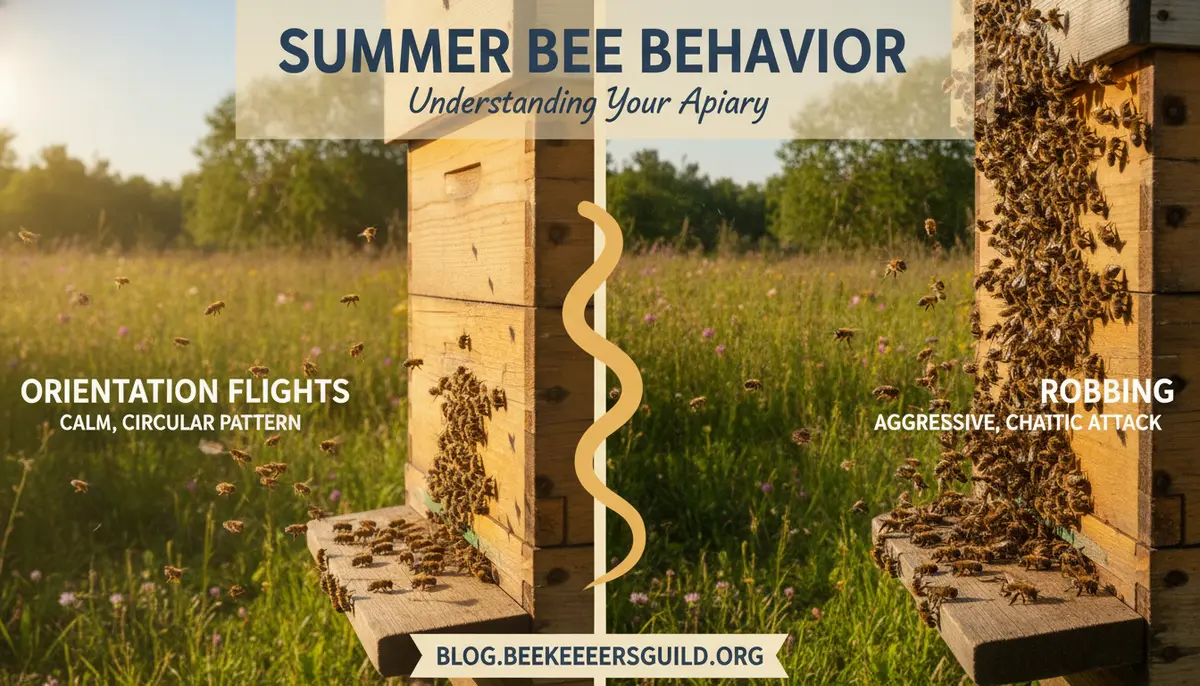
Orientation Flights vs. Robbing: Understanding Summer Bee Behavior in Your Apiary
The Midsummer Panic: Is It a Robbery or a Graduation?
For a new beekeeper, few sights are as pulse-pounding as walking into the apiary on a Tuesday afternoon and seeing a chaotic, swirling cloud of bees hovering directly in front of a hive entrance. The first instinct is often one of dread: "Oh no, my hive is being robbed!"
This reaction is understandable. In the world of beekeeping, robbing—where stronger colonies attack a weaker one to steal honey stores—is a genuine threat that can lead to the total collapse of a colony. However, as noted in the August 2026 issue of the American Bee Journal, what looks like a riot is often a sign of a thriving, healthy colony. These are "Orientation Flights," a vital rite of passage for the honey bee.
Understanding the nuance of honey bee behavior is a hallmark of Navigating the First Year: A Comprehensive Guide to Transitioning from Neophyte to Confident Beekeeper. Learning to distinguish between the "happy dance" of a growing hive and the desperate struggle of a hive under siege is one of the most important skills you can develop as a steward of these incredible insects.
What Are Orientation Flights?
Orientation flights are essentially "training sorties" for young bees. A honey bee’s life is strictly organized by age-based tasks, a phenomenon known as temporal polyethism. For the first three weeks of her life, a worker bee stays inside the hive, performing duties such as cleaning cells, tending to the queen, and nursing the larvae.
Around day 21, her physiology changes. She is ready to become a forager. But before she can fly miles away to find nectar and, more importantly, find her way back, she must calibrate her internal GPS.
The Mechanics of the Flight
During an orientation flight, the bee exits the hive and immediately turns around to face the entrance. She hovers, memorizing the specific visual landmarks of her home—the color of the hive, the shape of the landing board, and even the surrounding vegetation.
As she gains confidence, she flies in widening figure-eight patterns or circles. These "brief sorties," as the American Bee Journal describes them, begin just inches from the hive and gradually extend to several yards. Within minutes, the bee has mapped the hive’s location relative to the sun and local landmarks, ensuring she won't get lost when she begins her foraging career.
How to Identify Orientation Flights
If you are unsure whether your bees are orienting or being attacked, look for these specific behavioral markers. Orientation flights have a distinct "vibe" that is rhythmic and purposeful rather than frantic.
1. The "Facing the Hive" Rule
The most telling sign of an orientation flight is the direction the bees are facing. If you see hundreds of bees hovering in the air with their heads pointed toward the hive entrance, they are orienting. They are literally "taking a picture" of their home. In a robbing situation, bees are usually frantic, zig-zagging, and trying to find any crack or crevice to enter the hive.
2. The Time of Day
Orientation flights are highly predictable. They almost always occur on warm, sunny, calm afternoons. If you see a sudden burst of activity at 2:00 PM on a beautiful Tuesday that subsides by 2:30 PM, it was likely an orientation event. Robbing, while also common in summer, can happen at any time and often persists until the hive is picked clean or the sun goes down.
3. The Appearance of the Bees
Look closely at the bees in the air. Are they "fuzzy" and light-colored? New foragers are young bees, and they still retain much of their soft, downy hair. Robbers, on the other hand, are often older, "greasy-looking" foragers from other hives. They may have lost much of their hair from weeks of work, making them appear darker and shinier.
To get a better look at these details without getting too close and disrupting the flight, many beekeepers use a high-quality set of optics.
Identifying the Warning Signs of Robbing
While orientation is a sign of growth, robbing is a sign of danger. If you notice the following behaviors, you may need to take immediate action to save your colony.
Fighting on the Landing Board
In an orientation flight, there is no physical combat. The bees are simply flying. In a robbing scenario, you will see "wrestling" on the landing board. Guard bees will grab intruders, and you may see pairs of bees tumbling off the entrance and falling to the ground in a struggle.
The "High-Speed" Entry and Exit
Robber bees are in a hurry. They land and immediately scramble into the hive. When they leave, they are heavy with stolen honey, causing them to "dip" or fly sluggishly as they exit. Conversely, orienting bees are light and hover gracefully; they aren't carrying a heavy load of nectar yet.
The Presence of Wax Crumbs
During a severe robbing event, the attackers will frantically tear open wax cappings to get to the honey. This results in a "sawdust" of wax cappings on the landing board or the hive floor. Orientation flights leave no such debris.
Management Strategies for Summer Activity
As a beekeeper, your role during orientation flights is simply to observe and enjoy the spectacle. It is a sign that your queen is laying well and your population is expanding. However, because summer is also "robbing season" (especially during a nectar dearth), you should have the right tools on hand to intervene if the situation turns sour.
Using Entrance Reducers
If you suspect robbing, the first step is to reduce the entrance. A smaller entrance is much easier for a colony’s guard bees to defend. This is a fundamental part of the Essential Beekeeping Tools Every Newbie Needs: Beyond the Hive and Suit.
The Moving Method
In extreme cases of robbing, beekeepers may use a "robbing screen." This tool confuses the attackers by moving the entrance they are used to, while allowing the resident bees (who follow the scent of the hive) to find their way in through a bypass.
Why Orientation Flights are a Positive Metric
Beyond just being a fascinating behavior, orientation flights serve as a biological "health check" for the apiary.
- Population Growth: A large orientation flight confirms that a significant batch of brood has recently hatched and matured.
- Queen Productivity: Frequent orientation flights throughout the summer indicate that the queen is consistently laying and the hive is not "brood bound."
- Environmental Awareness: It shows the bees are reacting naturally to the weather and forage conditions.
If you go weeks during the summer without seeing any orientation activity, it may be time for a hive inspection. A lack of new foragers could indicate a failing queen or a high mite load that is shortening the lifespan of the workers. While we often worry about external threats like Tropilaelaps Redux: Preparing for the Next Great Threat to American Beekeeping, sometimes the most important data comes from simply watching the front door.
Conclusion: Trust the Process
The sight of an orientation flight is one of the most rewarding experiences in beekeeping. It represents the transition of a bee from a cloistered life in the dark of the hive to the wide-open world of the meadow.
By staying calm and looking for the specific markers of orientation—the hovering, the facing of the hive, and the midday timing—you can move from a state of panic to a state of appreciation. The next time you see that "cloud" of bees, take a moment to sit nearby, perhaps with a notebook in hand, and watch the next generation of foragers prepare for their first flight. It isn't a riot; it's a graduation.