
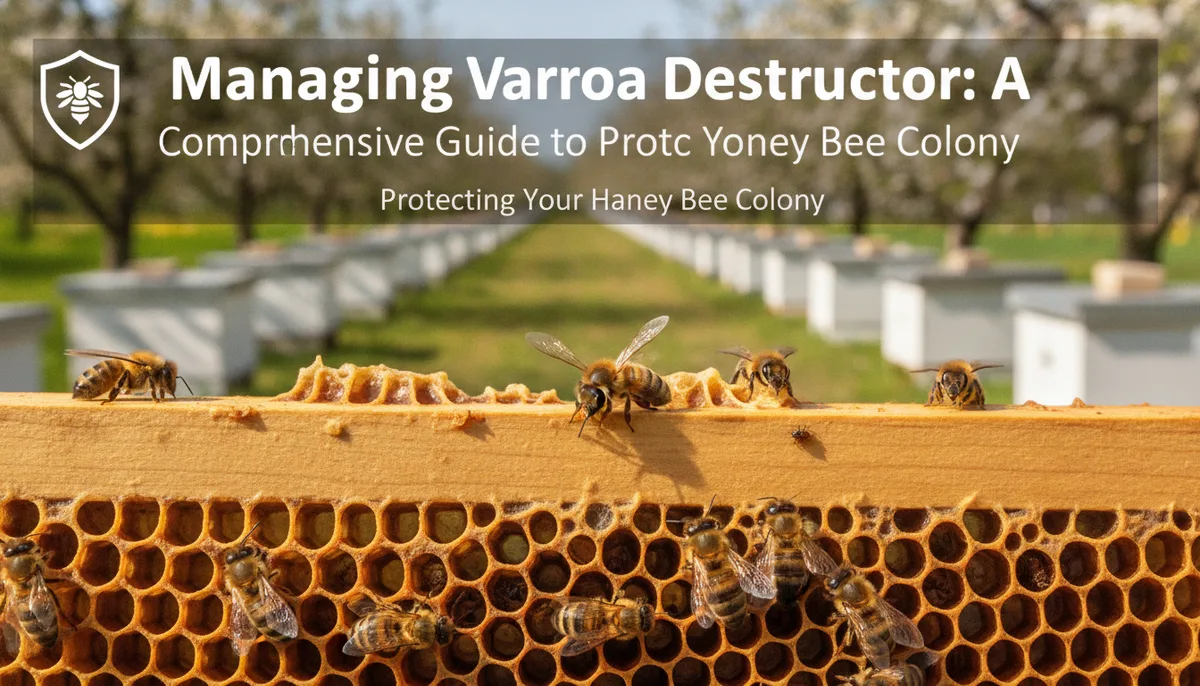
Managing Varroa Destructor: A Comprehensive Guide to Protecting Your Honey Bee Colony
The Invisible Threat: Why Varroa Destructor is the Beekeeper’s Greatest Challenge
For the modern beekeeper, the name Varroa destructor carries a weight of existential dread. As Roman Bondarenko, Beekeeper and Apitherapy Specialist, notes, this external parasitic mite is one of the most destructive pests currently facing U.S. bee colonies. Unlike many other pests that might simply nuisance a hive, Varroa is a fundamental threat to colony viability.
The mite does not merely "hitch a ride" on the bees. It is an active predator that feeds on both the brood (developing larvae) and adult honey bees. By consuming the bee's fat body—a vital organ responsible for immune function, pesticide detoxification, and overwintering energy—the mite leaves the bee physically weakened and immunologically compromised.
If left unchecked, an infestation can spiral out of control with terrifying speed. Because the mite population grows exponentially as the bee population peaks, a colony that looks healthy in June can be completely decimated by October. Understanding this parasite isn't just an academic exercise; it is the cornerstone of successful beekeeping.
The Life Cycle of the Enemy: From Brood to Adult
To fight Varroa, you must understand its reproductive strategy. The mite's life cycle is inextricably linked to the honey bee’s own development, making it incredibly difficult to eradicate without harming the host.
The Phoretic Phase
During this stage, adult female mites attach themselves to adult worker bees or drones. They often hide between the abdominal sternites (the underside of the bee), where they are difficult for the bee to groom off and where they have easy access to the bee's fat body tissues. This phase allows the mites to move around the hive and even spread to other colonies via drifting drones or robbing bees.
The Reproductive Phase
The real damage occurs inside the capped brood cells. A foundress mite will slip into a cell just before the workers cap it. Once the cell is sealed, she begins laying eggs. The first egg is usually male, and subsequent eggs are female. These offspring mate with each other inside the cell and feed on the developing bee pupa.
By the time the young bee emerges, it is often deformed, malnourished, and carrying several mites that are now ready to find new cells or attach to adult bees. This cycle is particularly devastating in drone brood, which has a longer developmental period, allowing the mites to produce more offspring per cycle.
The Viral Connection: More Than Just a Parasite
While the physical feeding of the mite is damaging, the secondary effects are often what ultimately kill the colony. Varroa destructor acts as a highly efficient vector for a variety of devastating viruses.
- Deformed Wing Virus (DWV): This is perhaps the most visible sign of a high mite load. Bees emerge with shriveled, useless wings and shortened abdomens. These bees cannot forage and are often expelled from the hive, leading to a rapid drop in the worker population.
- Acute Bee Paralysis Virus (ABPV): This can cause sudden death in adult bees, often leading to a "disappearing act" where the hive appears empty of adult bees while still containing honey and brood.
- Chronic Bee Paralysis Virus (CBPV): Results in trembling, bloated abdomens, and a greasy, hairless appearance in adult bees.
As Roman Bondarenko emphasizes, these infestations reduce worker lifespan significantly. In a healthy hive, "winter bees" must live for several months to keep the queen warm and start the spring brood. If these bees are parasitized by Varroa in the fall, they will not live long enough to see the spring, leading to late-winter colony loss.
Monitoring Techniques: Knowing Your Numbers
You cannot manage what you do not measure. Many new beekeepers make the mistake of assuming their bees are "fine" because they don't see mites on the bees' backs. However, because mites hide on the underside of bees and inside capped cells, visual inspection is notoriously unreliable.
The Alcohol Wash
This is the "gold standard" for mite monitoring. A sample of approximately 300 bees (half a cup) is taken from the brood nest (ensuring the queen is NOT in the sample). The bees are submerged in isopropyl alcohol or windshield washer fluid and shaken. This kills the bees but dislodges the mites, allowing for an accurate count. A threshold of 2-3 mites per 100 bees (6-9 mites in a 300-bee sample) is often the "action level" where treatment becomes necessary.
The Powdered Sugar Shake
For those who cannot bring themselves to kill 300 bees, the sugar shake is a non-lethal alternative. Bees are dusted with powdered sugar, which causes the mites to lose their grip and fall through a mesh screen. While better than no testing at all, it is generally less accurate than the alcohol wash, especially in humid conditions where the sugar can clump.
If you are just starting out, it is vital to have the right gear on hand. Check out our guide on Essential Beekeeping Tools Every Newbie Needs: Beyond the Hive and Suit to ensure you are prepared for monitoring.
Integrated Pest Management (IPM) Strategies
Managing Varroa is not about a single "silver bullet" chemical. Instead, successful beekeepers use Integrated Pest Management (IPM), a tiered approach that starts with low-intervention cultural practices and moves toward chemical treatments only when necessary.
Cultural and Mechanical Controls
- Screened Bottom Boards: These allow mites that fall off bees to drop through the bottom of the hive and onto the ground, preventing them from re-entering the colony.
- Drone Brood Removal: Since Varroa prefer drone brood, beekeepers can use specialized drone foundation. Once the drone cells are capped, the frame is removed and frozen to kill the mites inside, then returned to the hive.
- Breaking the Brood Cycle: Caging the queen for a short period creates a "brood-less" window. This forces all mites into the phoretic phase, making them much more vulnerable to treatments like Oxalic Acid.
Chemical Controls
When mite levels exceed the safety threshold, chemical intervention is required to save the colony.
- Organic Acids: Formic acid (found naturally in ants) and Oxalic acid (found in spinach and rhubarb) are highly effective and leave minimal residue in wax. Formic acid is unique because it can penetrate capped brood cells.
- Essential Oils: Products based on Thymol (thyme oil) can be effective but are highly temperature-sensitive.
- Synthetic Miticides: While effective, there is growing concern regarding mites developing resistance to these chemicals.
The Critical Importance of Timing
Timing is the most overlooked aspect of Varroa management. Many beekeepers wait until they harvest their honey in late August or September to treat. By then, it is often too late.
The mites have already spent the summer multiplying and infecting the larvae that will become the "winter bees." Even if you kill every mite in the hive in September, the damage to the winter bees' immune systems is already done. To ensure winter survival, mite levels must be brought down before the colony begins producing its winter population.
For those Navigating the First Year: A Comprehensive Guide to Transitioning from Neophyte to Confident Beekeeper, understanding the seasonal rhythm of Varroa is the difference between a thriving spring apiary and an empty box of dead bees.
Looking Ahead: New Challenges on the Horizon
While Varroa destructor is currently the primary threat, the beekeeping world is bracing for new challenges. The spread of viruses and the potential arrival of other parasites, such as those discussed in Tropilaelaps Redux: Preparing for the Next Great Threat to American Beekeeping, mean that beekeepers must remain vigilant and informed.
Breeding programs focusing on VSH (Varroa Sensitive Hygiene) bees—colonies that can detect and remove mite-infested brood—offer hope for a future where chemical intervention is less necessary. However, until these traits are stabilized across the general bee population, active monitoring and management remain the beekeeper's primary duty.
Conclusion: Vigilance as a Virtue
The presence of Varroa destructor has fundamentally changed beekeeping. It is no longer a "set it and forget it" hobby. To keep bees today is to be a steward of their health, requiring a deep understanding of parasite biology and a commitment to regular monitoring.
By utilizing a combination of high-quality equipment, such as those found in the Best Beginner Beekeeping Kits of 2024, and implementing a rigorous IPM strategy, you can protect your colonies from the "persistent threat" and enjoy the rewards of a healthy, buzzing backyard apiary. Remember: a healthy hive starts with a beekeeper who knows their mite count.