
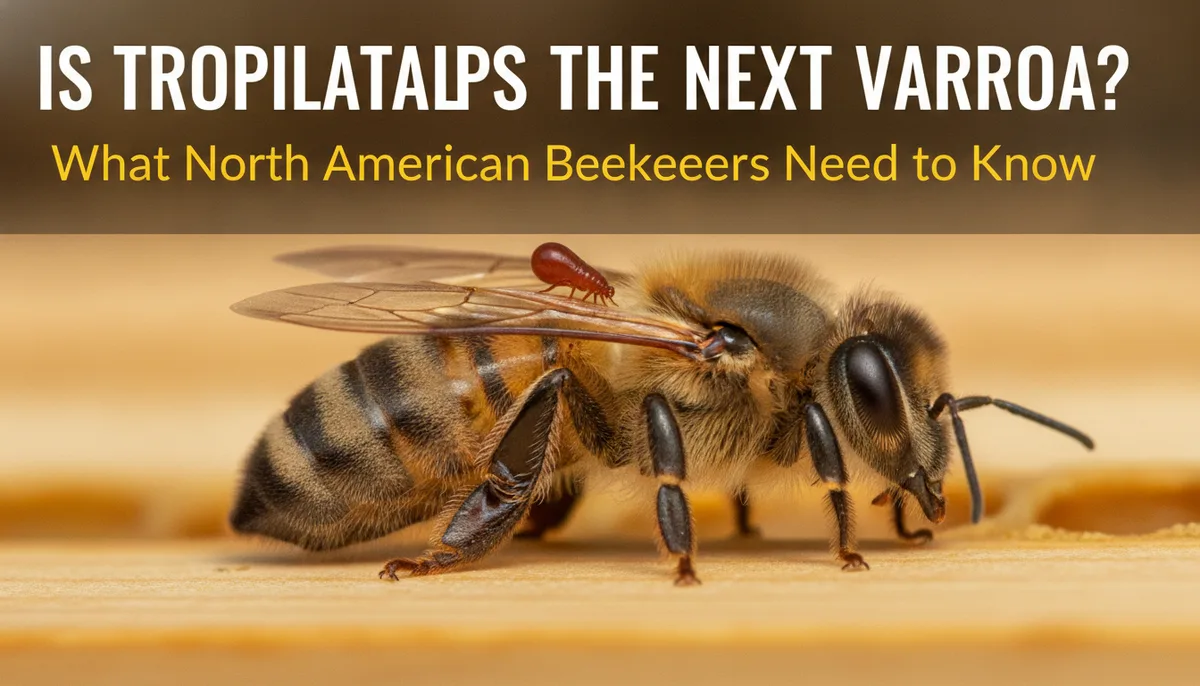
Is Tropilaelaps the Next Varroa? What North American Beekeepers Need to Know
For decades, the North American beekeeping industry has been defined by its struggle against Varroa destructor. It is the "devil we know," a parasite that has fundamentally altered how we manage colonies, select genetics, and monitor hive health. However, a new shadow is looming on the horizon—one that many experts believe could make the Varroa crisis look like a minor inconvenience.
The parasite in question is the Tropilaelaps mite. Native to Asia and originally a parasite of the giant honey bee (Apis dorsata), these mites have successfully jumped to the Western honey bee (Apis mellifera). While North America remains officially free of these mites for now, the beekeeping community is divided: is this a distant threat we can ignore, or an inevitable catastrophe accelerated by a changing climate?
Understanding the Tropilaelaps Lifecycle: Why It’s a Formidable Foe
To understand why Tropilaelaps is so dangerous, we must look at its biology. In many ways, it is a "refined" version of Varroa, optimized for rapid destruction.
Unlike Varroa mites, which can survive for weeks on adult bees (the phoretic stage), Tropilaelaps mites have a very short phoretic stage—often less than two days. They are physically incapable of feeding on adult bees for long periods because their mouthparts cannot pierce the adult bee's exoskeleton effectively. This means they are almost always found within the brood cells.
This biological quirk makes them incredibly difficult to detect during a standard inspection. While a beekeeper might spot a Varroa mite riding on the thorax of a worker bee, you are unlikely to ever see a Tropilaelaps mite outside of a cell unless the infestation is already at a terminal level. Furthermore, their reproductive cycle is roughly twice as fast as Varroa. A colony can go from "healthy" to "collapsed" in a matter of weeks, rather than the months-long decline typically seen with Varroa.
The Great Climate Debate: Will They Survive Here?
There is a significant debate within the scientific community regarding the potential range of Tropilaelaps in North America. Historically, these mites have been classified as tropical pests. Because they cannot survive more than a few days without access to honey bee larvae, they require a colony that maintains a continuous brood nest year-round.
Some researchers argue that the cold winters of the northern United States and Canada act as a natural barrier. If a colony goes "broodless" during the winter, the mites will starve and the infestation will self-terminate.
However, this optimism is tempered by two factors:
- Warming Trends: As average winter temperatures rise, more colonies in temperate zones are maintaining small patches of brood throughout the year.
- Microclimates: A honey bee cluster is a master of thermoregulation. Even in freezing temperatures, the center of the cluster remains warm enough to support brood. If the mites can survive the transit between cells within the warmth of the cluster, the external temperature may not matter as much as previously thought.
For a deeper dive into the logistical and environmental challenges of this threat, see our detailed analysis in Tropilaelaps Redux: Preparing for the Next Great Threat to American Beekeeping.
Detection Challenges for the Backyard Beekeeper
Because Tropilaelaps mites are smaller (about half the size of Varroa) and much faster, they are notoriously difficult to monitor. They move with a "scuttling" motion that can make them look more like tiny spiders than the slow-moving, crab-like Varroa.
For beekeepers used to the "alcohol wash" method, Tropilaelaps presents a problem. Since the mites spend so little time on adult bees, an alcohol wash may yield a "zero" count even in a heavily infested hive.
Signs of Infestation to Watch For:
- Irregular Brood Patterns: Often mistaken for a failing queen or European Foulbrood (EFB).
- Deformed Wing Virus (DWV): Like Varroa, Tropilaelaps is a vector for viruses. If you see bees with shriveled wings but your Varroa counts are low, you should be suspicious.
- "Crawlers": Young bees that are evicted from the hive because they are too weak or deformed to function.
- Perforated Cappings: Bees attempting to hygienicly remove infested larvae will leave small, irregular holes in the brood cappings.
To effectively monitor for these pests, beekeepers may need to invest in higher-quality magnification tools to inspect pupae directly.
The Economic and Ecological Stakes
The arrival of Tropilaelaps in North America would not just be a headache for hobbyists; it would be an existential threat to commercial pollination. Our current agricultural system relies heavily on the migratory movement of bees. If Tropilaelaps were detected in a major hub like California or Florida, the resulting quarantines could freeze the movement of millions of colonies, leading to crop failures in everything from almonds to apples.
Furthermore, the "Varroa-centric" breeding programs that have spent decades developing VSH (Varroa Sensitive Hygiene) traits may not offer protection against Tropilaelaps. While some hygienic behaviors overlap, the sheer speed of Tropilaelaps reproduction can overwhelm even the most fastidious colonies.
Why Federal Research is Our First Line of Defense
The fight against invasive species is not something an individual beekeeper can win alone. It requires robust federal oversight, border inspections, and ongoing genomic research. This is why the stability of our national bee labs is so critical.
The loss of specialized research facilities can lead to a "blind spot" in our national security. If we lose the ability to study these mites in a controlled environment before they arrive on our shores, we will be forced to learn "on the fly" while our colonies are dying. For more context on why this infrastructure is currently at risk, read The Beltsville Crisis: Why Losing Federal Bee Research Threatens the Future of American Beekeeping.
Practical Steps for Beekeepers Today
While Tropilaelaps has not yet been confirmed in North American apiaries, "pre-vulnerability" is the best mindset to adopt.
1. Improve Your Inspection Skills
Don't just look for the queen and honey stores. Practice pulling a few drones or worker pupae during your regular inspections to check for mites. If you are a new beekeeper, learning the baseline of what "healthy" looks like is essential. If you are still getting your bearings, our guide on Navigating the First Year: A Comprehensive Guide to Transitioning from Neophyte to Confident Beekeeper provides a solid foundation for hive observation.
2. Maintain Strict Biosecurity
Avoid buying "cheap" queens or packages from unwell-regarded sources that may have skirted importation laws. The most likely way Tropilaelaps will enter the country is through the illegal or accidental transport of live bees or infested equipment.
3. Support Local Research
Stay informed about USDA-APHIS (Animal and Plant Health Inspection Service) surveys. Many states participate in the National Honey Bee Survey, which specifically looks for Tropilaelaps. If your apiary is selected for a survey, participate. The data collected is our best chance at early detection.
4. Invest in Proper Equipment
Having the right tools for a deep-dive inspection can make the difference between catching a problem early and losing an entire yard.
Final Thoughts: Vigilance Without Panic
Is Tropilaelaps nothing to fear? Certainly not. It is a biological powerhouse that has already caused significant damage in Southeast Asia and parts of the Middle East. However, panicking serves no purpose.
The North American beekeeping community is more connected and informed than ever before. By understanding the biology of this mite, advocating for the protection of federal research facilities, and maintaining high standards of hive hygiene, we can prepare for the "when" rather than just the "if."
For now, we are free of Tropilaelaps. Let’s use this time wisely to ensure that if it does arrive, it finds a beekeeping community that is educated, prepared, and ready to fight back.