
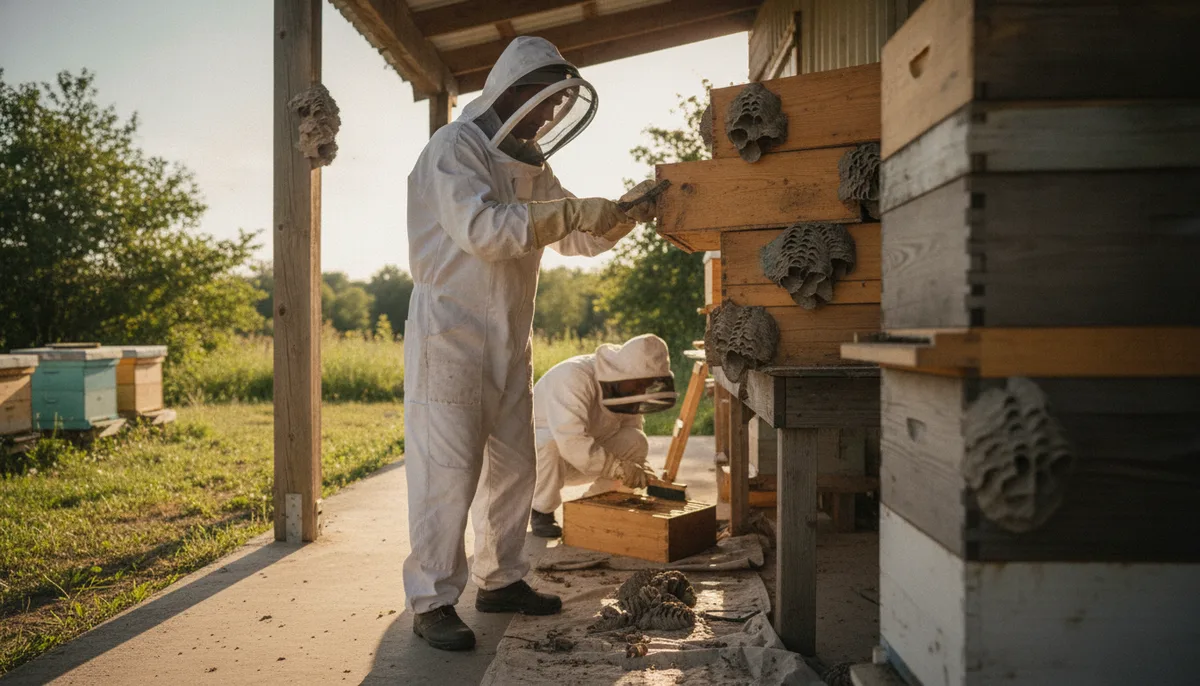
Uninvited Guests: Managing Mud Dauber Wasps in Your Honey Supers
Finding a mud dauber nest inside a honey super is a rare and startling experience for any beekeeper. You go into the harvest expecting liquid gold and instead find a series of dried mud tubes firmly affixed to your honeycomb foundation. For many, the immediate question isn't just "How did this get here?" but "Why did my bees let this happen?"
This scenario recently surfaced in the beekeeping community involving Buckfast bees—a breed known for its productivity and gentleness. Finding viable wasp larvae inside a functioning hive challenges our assumptions about hive security and the territorial nature of honey bees. Understanding the biology of the intruder and the temperament of the colony is essential for maintaining a clean, productive apiary.
Identifying the Intruder: The Solitary Mud Dauber
Before panicking about a "wasp infestation," it is crucial to identify exactly what has moved into your hive. Mud daubers (Sceliphron or Chalybion species) are significantly different from the social wasps beekeepers usually fear, such as yellowjackets or hornets.
Mud daubers are solitary wasps. They do not live in colonies, they do not have a queen, and they do not "defend" a nest in the way social insects do. Their life cycle involves the female building small tubes out of mud, which she stocks with paralyzed spiders to serve as food for her developing larvae. Because they are not looking to steal honey or eat bee larvae, they are often ignored by the honey bees.
In the case of finding these nests on honeycomb foundation, the wasp likely found a quiet, low-traffic corner of a honey super. If the super was not fully "covered" by bees—perhaps during a period where the colony was focusing its efforts on the brood nest below—the wasp found a dry, protected environment perfect for its mud structures.
The Temperament Factor: Why Buckfast Bees Might Tolerate Intruders
Buckfast bees are a celebrated hybrid, originally developed by Brother Adam at Buckfast Abbey. They are prized for their honey production, resistance to certain diseases, and, most notably, their extreme gentleness. However, "gentleness" toward a beekeeper can sometimes translate to a higher threshold for tolerance toward other "neutral" insects.
Honey bees are masters of energy conservation. If an intruder like a mud dauber is not emitting pheromones associated with predation and is not competing for resources (honey and pollen), the colony may simply decide that the energy required to kill and remove the wasp—and the risk of injury to the workers—is not worth the effort.
This is particularly true in the upper honey supers. During the late season, as the queen slows down and the bees begin to cluster more tightly, the far reaches of the supers may become "unpatrolled" territory. To a mud dauber, a sturdy beehive with a small gap in the cover or an ill-fitting box is the ultimate real estate.
Impact on the Honey Harvest
The primary concern when finding a mud nest in your supers is the cleanliness of your harvest. While mud daubers are not "dirty" in the traditional sense, their nests are made of dried earth and contain biological matter (paralyzed spiders and wasp pupae).
If you find a nest during your harvest, do not run the frame through your extractor immediately. The centrifugal force will likely break the mud nest apart, sending debris into your honey. Instead, follow these steps:
- Isolation: Set the affected frame aside from the rest of your harvest.
- Manual Removal: Use a to carefully scrape the mud nest off the foundation. Do this away from your extraction area to prevent dust from settling on other frames.
- Inspection: Check if the mud has compromised the wax cells. If the nest was built on plastic foundation, you can usually scrape it clean down to the base. If it was on thin wax foundation, you may need to cut out that section of the comb.
- Cleaning: Use a damp, lint-free cloth to wipe away any remaining mud residue.
For those managing a small-scale apiary, maintaining the integrity of each frame is vital. For more on the mechanics of processing your crop, see our guide on the Best Honey Extractors for Small Scale Harvests: A Backyard Beekeeper’s Guide.
Strengthening Hive Security and Maintenance
While a mud dauber nest is more of a nuisance than a threat, its presence indicates that there are gaps in your hive’s defenses. A secure hive should be difficult for any non-bee resident to enter.
Check for Equipment Gaps
As woodenware ages, it can warp. A small gap between the inner cover and the honey super, or a crack in the side of a box, is all a solitary wasp needs to enter. Inspect your boxes annually. If you can see light through the joints of your supers, it's time for repairs or replacement. Using or simply ensuring boxes are seated flush can mitigate this risk.
Maintain Colony Density
The best defense against any intruder is a "boiling" population of bees. When every inch of the honeycomb is covered by nurse bees or foragers, there is no physical space for a wasp to build a nest. If you find mud nests or other intruders, it may be a sign that the colony is "rattled" or that you have provided too much space (too many supers) for the number of bees currently in the hive.
Tools for Maintenance
Keeping your frames clean and your hive boxes in good repair requires a few specific tools. Beyond the standard smoker and suit, a dedicated and a sharp hive tool are indispensable for dealing with unexpected "additions" to your comb. You can find a full list of these requirements in our article on Essential Beekeeping Tools Every Newbie Needs: Beyond the Hive and Suit.
Long-Term Hive Health and Winter Preparation
Finding these nests usually happens in the autumn as beekeepers pull their final supers. This is a critical time for the hive as they transition into winter mode. The presence of intruders in the supers should prompt a closer look at the overall health of the colony.
If the bees were too "distracted" or weak to defend the supers, you must ensure they are strong enough to survive the winter. This includes checking mite counts and ensuring they have adequate stores. A colony that allows a wasp to move in may also be a colony that struggles with temperature regulation or moisture control in the colder months.
Understanding the state of your honey is also part of this seasonal transition. If you find your honey is thickening or behaving oddly after the harvest, it may be due to environmental factors rather than the presence of the wasps. For a deeper dive into these changes, read about The Science of the Solid: Understanding Honey Crystallization and Critical Winter Hive Maintenance.
Conclusion: Lessons from the Mud Dauber
The discovery of a mud dauber nest in a honey super is a fascinating look into the hive's ecosystem. It serves as a reminder that a beehive is not a closed system, but a living environment that interacts with the local fauna.
While the Buckfast bees' tolerance of the wasp might seem like a lapse in security, it is often just a reflection of their efficient, non-aggressive nature. By identifying the intruder, cleaning the frames properly, and tightening up hive maintenance, you can ensure that your honey harvest remains pure and your bees remain the sole occupants of their home. Keep your equipment tight, your colonies strong, and your hive tool ready—the apiary always has a way of surprising you.