
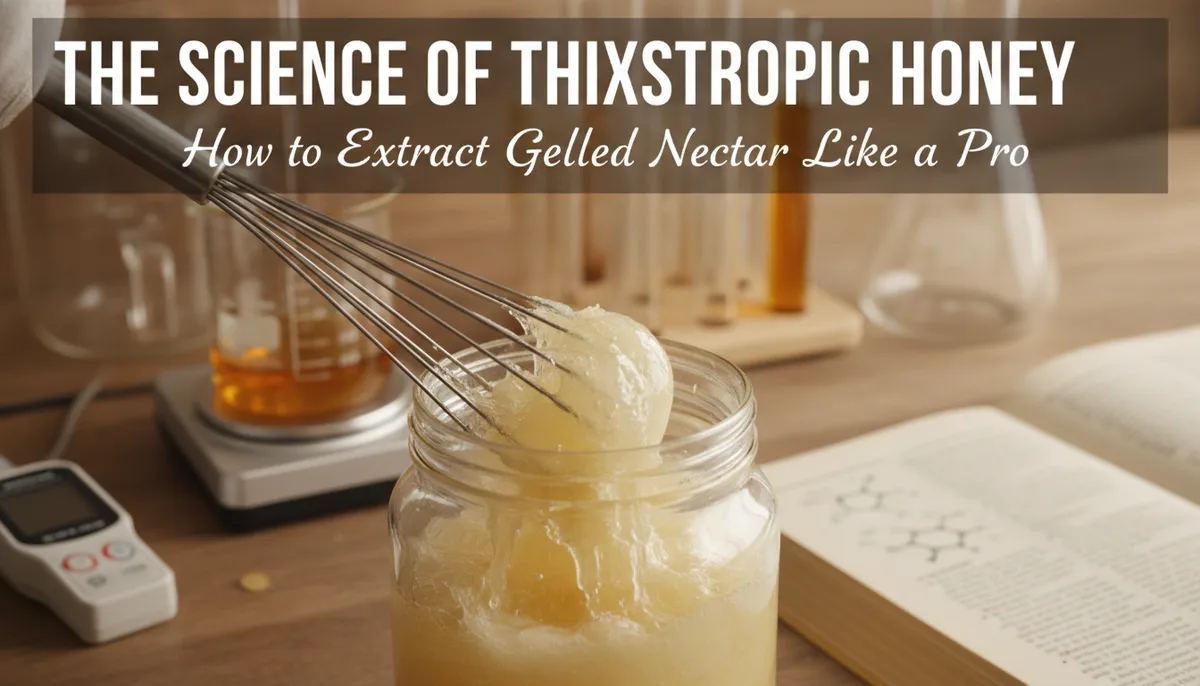
The Science of Thixotropic Honey: How to Extract Gelled Nectar Like a Pro
Understanding the Mystery of Thixotropic Liquids
In the world of beekeeping, we often talk about honey as a simple viscous liquid—something that flows like syrup, albeit slowly when cold. However, nature occasionally presents us with a substance that defies the standard rules of fluid dynamics. This phenomenon is known as thixotropy.
While the word "thixotropic" rarely makes it into everyday conversation, you encounter these strange materials more often than you might realize. If you have ever had to smack the bottom of a glass ketchup bottle to get the sauce moving, you have interacted with a thixotropic liquid. Under normal rest, the ketchup acts like a solid or a very thick gel. When you apply stress—via a shake or a smack—it suddenly "thins" and flows freely.
For beekeepers, particularly those in regions where Ling Heather (Calluna vulgaris) or Manuka (Leptospermum scoparium) flourish, thixotropy is not just a scientific curiosity; it is a significant logistical hurdle. Understanding the molecular "secret" of these gelled honeys is the first step toward a successful harvest.
The Science of "Gelled" Honey: Newtonian vs. Non-Newtonian Fluids
To understand why some honeys behave differently, we must look at the physics of viscosity. Most honey is a "Newtonian fluid," meaning its viscosity (thickness) stays constant regardless of how much you stir it. The only thing that significantly changes the flow of standard clover or wildflower honey is temperature.
Thixotropic honeys are "Non-Newtonian." Specifically, they exhibit time-dependent shear-thinning. At rest, the proteins or complex carbohydrates within these honeys (particularly the high protein content in Heather honey) form a three-dimensional network that traps the liquid. This gives the honey a jelly-like consistency. If you tip a jar of fresh Heather honey on its side, it won't spill; it stays firmly in place.
However, once you apply "shear stress"—mechanical agitation like stirring, shaking, or poking—this internal network collapses. The honey transforms from a gel into a liquid. If left alone again, the network eventually reforms, and the honey returns to its gelled state. This unique characteristic is why these honeys are so highly prized for their texture and mouthfeel, but it is also why they are a nightmare to extract using traditional methods.
When working with such unique varieties, keeping detailed records is essential. Using The Art of the Beekeeper’s Journal: How Observation Transforms Your Apiary can help you track which forage sources lead to thixotropic yields in your specific microclimate.
The Extraction Challenge: Why Your Centrifuge is Failing
A standard centrifugal extractor works on a simple principle: the frames spin, and the force pulls the liquid honey out of the cells and onto the walls of the tank. This works perfectly for Newtonian honeys. But if you put a frame of fully capped Heather honey into an extractor and spin it, you will likely find that the honey stays exactly where it is.
Because the honey is in a gel state, the centrifugal force isn't "sharp" enough to break the thixotropic bond. You can spin the extractor until the frames break, and the honey will remain stubbornly lodged in the wax.
Historically, beekeepers dealt with this by "pressing" the honey. They would cut the comb out of the frames, crush it, and squeeze it through a heavy-duty press. While effective, this method destroys the comb, forcing the bees to expend massive amounts of energy and nectar to rebuild it the following season. In the era of modern beekeeping, we look for ways to preserve the "drawn comb," which is a beekeeper's most valuable asset.
The evolution of these techniques is a fascinating part of our history. You can learn more about how far we've come in 1877: The Year That Defined Modern Beekeeping Equipment.
The Secret Weapon: The Honey Loosener
To extract thixotropic honey without destroying the comb, you must "trick" the honey into becoming a liquid. This is achieved through mechanical agitation before the frames ever enter the extractor. The tool designed for this job is called a honey loosener.
A honey loosener consists of a bed of spring-loaded needles. When the device is pressed against the face of a capped (or uncapped) frame, the needles penetrate deep into each individual cell. As the needles move in and out, they provide the necessary shear stress to break the protein bonds in the honey.
How to Use a Honey Loosener Effectively:
- Uncap First: Use your preferred uncapping tool to remove the wax cappings.
- Apply the Loosener: Press the needles into the cells. Some professional models are hand-held, while others are bench-mounted machines that process the entire frame at once.
- Work Quickly: Once the honey is agitated, it begins its transition to a liquid state. You have a limited window of time to get those frames into the extractor and spin them before the honey begins to "re-gel."
- Spin at High Speed: Even when loosened, thixotropic honey is thicker than average. A high-quality extractor is necessary to finish the job.
Choosing the Right Extractor for Gelled Honey
Not all extractors are created equal when it comes to thixotropic varieties. If you are dealing with a significant amount of Heather or Manuka honey, a radial extractor (where frames sit like spokes on a wheel) may struggle to pull the thick liquid out.
Many professional Heather honey producers prefer a tangential extractor. In a tangential setup, the face of the comb is parallel to the extractor wall, allowing the centrifugal force to act directly on the honey. While this requires flipping the frames to empty both sides, it provides the maximum "pull" needed to move stubborn, gelled nectar.
Regardless of the extractor you use, safety is paramount. High-speed extraction can lead to sticky situations and potential stings if you are working near an active apiary. Always ensure you are protected with Top-Rated Bee Suits for Maximum Protection: Stay Safe and Cool in the Apiary.
Preserving the Quality: Why Agitation Trumps Heat
A common mistake beginners make when facing "stuck" honey is to turn up the heat. While warming honey does lower its viscosity, it is a dangerous game.
Thixotropic honeys, especially Heather honey, are famous for their delicate aromatic profiles and high enzyme content. If you heat the honey enough to fully break the thixotropic gel through temperature alone, you risk:
- Caramelization: Darkening the honey and altering its flavor.
- HMF Increase: Raising the levels of hydroxymethylfurfural, which can be a sign of heat damage.
- Enzyme Loss: Destroying the beneficial properties that make premium honeys like Manuka so valuable.
Mechanical agitation with a loosener allows you to extract at "hive temperature" (around 95°F / 35°C), preserving the raw, natural integrity of the product.
Post-Extraction: Handling and Bottling
Once you have successfully extracted your thixotropic honey, the work isn't quite over. Because the honey will return to a gel state in the jar, it is prone to trapping air bubbles. These bubbles can give the honey a cloudy appearance, which some consumers dislike, though others see it as a hallmark of authenticity.
To achieve a clear, professional look:
- Settle in a Warm Room: Let the honey sit in a bottling tank at a slightly elevated temperature (around 100°F) for 24 hours. This allows air bubbles to rise to the top before the gel sets.
- Use a Refractometer: Thixotropic honeys often have a naturally higher moisture content than standard honeys. Ensure your honey is shelf-stable (ideally below 18-19% moisture) before bottling.
The Value of the Effort
Extracting thixotropic honey is undeniably more labor-intensive than processing standard wildflower honey. It requires specialized tools, more time, and a deeper understanding of fluid physics. However, the rewards are significant.
Heather and Manuka honeys are among the most expensive and sought-after varieties in the world. Their unique texture—that "melt-on-the-tongue" gel—is a sensory experience that cannot be replicated by any other food. By mastering the secret of thixotropic liquids, you aren't just harvesting honey; you are capturing a rare botanical phenomenon that represents the pinnacle of the beekeeper's craft.