
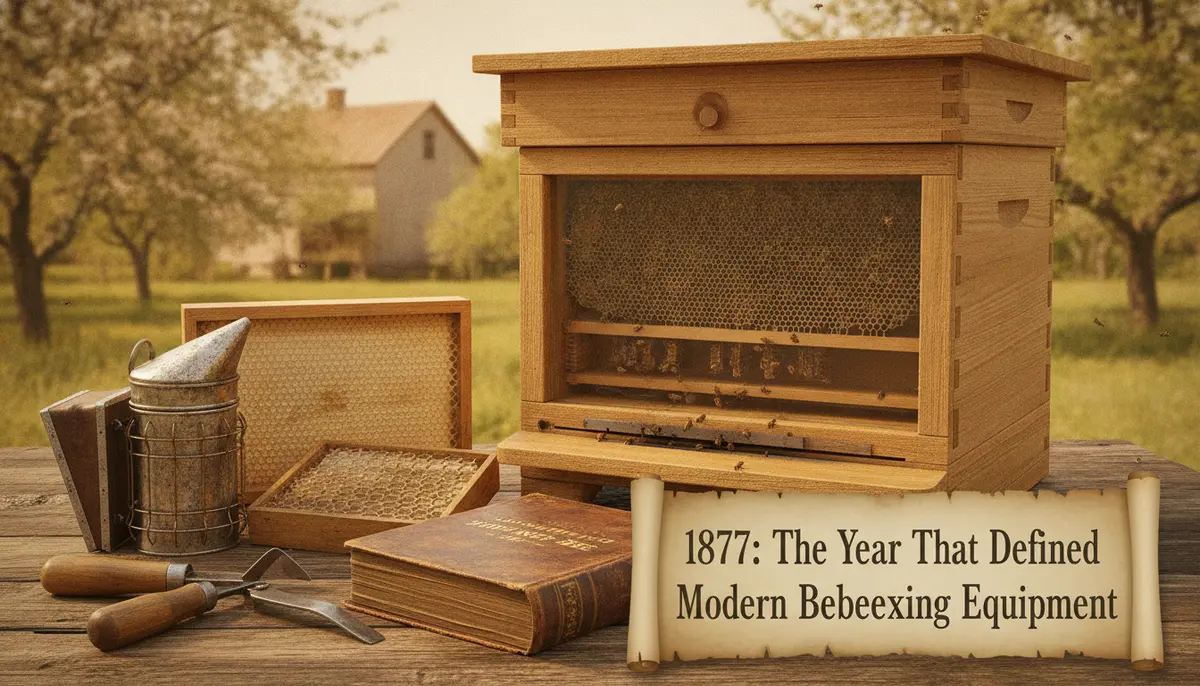
1877: The Year That Defined Modern Beekeeping Equipment
The history of beekeeping is not merely a dry timeline of dates and names; it is a story of engineering, observation, and a relentless pursuit of efficiency. For many serious apiarists, the late 19th century—specifically the year 1877—represents a "Golden Age" of innovation. This was the era when the rudimentary practices of the past were replaced by the mechanical precision that defines the modern apiary.
To understand where we are going, we must look at where we began. Much of our knowledge of this era comes from the archives of the American Bee Journal (ABJ) and Bee Culture. However, as many historians have discovered, the records we have are often incomplete.
The Archival Challenge: The Mystery of the Missing Wraps
In the late 1980s, a dedicated beekeeper took out a bank loan to acquire a complete collection of the American Bee Journal and Bee Culture, dating back to their very first issues. At the time, this was a monumental investment in knowledge. Today, while digital copies have made these texts more accessible, they still suffer from a significant historical void: the loss of the "wraps."
In the 19th century, journals were often published with soft paper covers known as wraps. These wraps contained the advertisements, new product announcements, and local notices that didn't make it into the "formal" bound volumes. When libraries or collectors bound these journals into hardback books, they often stripped away the wraps to save space.
This practice resulted in a massive loss of information regarding the equipment of 1877. We have the articles discussing the theory of beekeeping, but the specific commercial details—the prices, the first-edition sketches of new smokers, and the competing claims of manufacturers—were often discarded. Despite this, the surviving text tells a story of a year that changed everything.
1877: The Industrial Revolution of the Apiary
By 1877, the beekeeping world was buzzing with the possibilities of the Langstroth hive, which had been introduced decades earlier. However, the hive itself was only part of the equation. To manage large-scale apiaries, beekeepers needed better tools.
The year 1877 saw the refinement of three specific technologies that remain the backbone of beekeeping today:
- The Bellows Smoker
- The Comb Foundation Mill
- The Centrifugal Honey Extractor
If you are a new beekeeper today, you likely started with a kit that includes these items. To see how these tools have evolved into the user-friendly versions we have now, you might explore the Best Beginner Beekeeping Kits of 2024: Start Your Backyard Apiary with Confidence.
The Evolution of the Bee Smoker
Before 1877, "smoking" bees was a clumsy and often dangerous affair. Beekeepers would blow smoke from a pipe or use a simple tin tube filled with burning rags. It was Moses Quinby who revolutionized this by attaching a bellows to a tin firebox.
In 1877, the Quinby smoker was being refined and imitated. This tool allowed for one-handed operation, giving the beekeeper a free hand to work the frames. It was the difference between a panicked, defensive colony and a calm, workable hive. The design was so effective that the basic silhouette of a 1877 smoker is almost identical to what you would buy today.
stainless steel bee smoker with bellows
The Foundation of Success: The 1877 Wax Mill
Perhaps the most significant leap forward in 1877 was the commercialization of comb foundation. While the idea of giving bees a "head start" with a sheet of embossed wax had existed for years, the machinery to produce it reliably was perfected in the late 1870s.
A.I. Root, a giant in beekeeping history, began mass-producing foundation mills. These heavy, hand-cranked rollers would press the hexagonal pattern of worker cells into thin sheets of beeswax. This innovation allowed beekeepers to ensure that bees built straight, manageable combs that could be easily inspected and extracted without destroying the hive's structural integrity.
Today, we take foundation for granted, often opting for plastic or pre-wired wax, but in 1877, this was cutting-edge technology that dramatically increased honey yields.
Extracting the Future: The Centrifugal Revolution
Before the invention of the honey extractor, harvesting honey was a destructive process. Combs were crushed, and the honey was strained, meaning the bees had to spend precious time and energy rebuilding the wax from scratch.
By 1877, the centrifugal extractor—which used rapid spinning to sling honey out of the cells while leaving the comb intact—had become the industry standard. The 1877 models were often large, heavy cast-iron machines, but they proved a vital point: wax is expensive for bees to produce (requiring roughly 8 pounds of honey to produce 1 pound of wax). By returning the empty combs to the hive, beekeepers could double or triple their seasonal harvest.
The Importance of Observation and Record-Keeping
The beekeepers of 1877 weren't just inventors; they were meticulous observers. Because they were using "new" technology, they had to document what worked and what didn't. This tradition of careful documentation is something every modern beekeeper should emulate.
In the same way that we look back at the American Bee Journal of 1877 to understand the evolution of the smoker, your own journals serve as the historical record for your specific micro-climate and colony genetics. For more on how to develop this skill, read The Art of the Beekeeper’s Journal: How Observation Transforms Your Apiary.
Why 1877 Matters to You Today
It is easy to look at an old woodcut from 1877 and see it as a relic of a bygone era. However, the challenges faced by those beekeepers are remarkably similar to our own. They were dealing with the transition to industrial agriculture, the emergence of new bee diseases, and the need for standardized equipment.
When we study the "new" equipment of 1877, we realize that beekeeping is a balance of tradition and innovation. We use the same bellows smoker design because it works, but we also look toward modern research to solve new problems. For example, the loss of historical research facilities, as discussed in The Beltsville Crisis: Why Losing Federal Bee Research Threatens the Future of American Beekeeping, reminds us that progress is not always a straight line—it requires constant advocacy and preservation of knowledge.
Conclusion: Honoring the Past to Protect the Future
The missing "wraps" of the 1877 American Bee Journal serve as a poignant reminder that information is fragile. As beekeepers, we are the stewards of a craft that spans centuries. By understanding the mechanical breakthroughs of 1877—the smokers, the mills, and the extractors—we gain a deeper appreciation for the tools we use every time we step into the apiary.
Whether you are using a vintage-style smoker or the latest high-tech hive monitor, you are part of a lineage of innovators who, over 140 years ago, decided that there was a better way to work with the honeybee. By keeping our own records and studying the archives of the past, we ensure that the "Golden Age" of beekeeping never truly ends.