
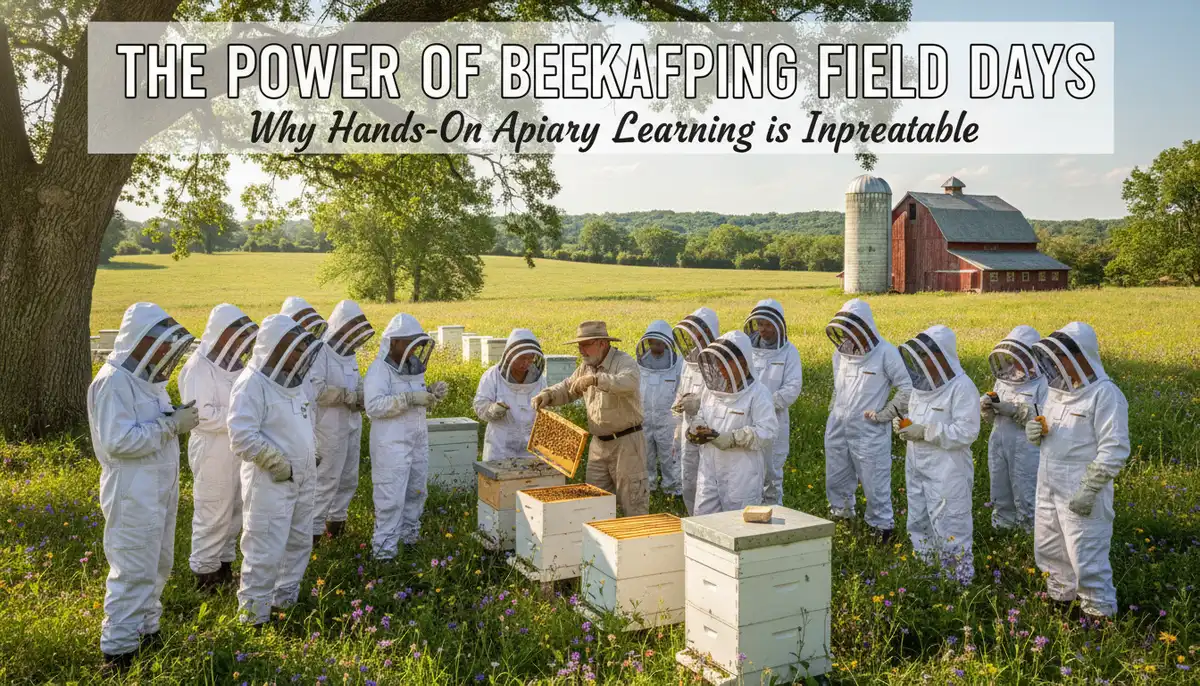
The Power of Beekeeping Field Days: Why Hands-On Apiary Learning is Irreplaceable
The Sensory Shift: From Books to the Bee Yard
There is a profound difference between reading about the pheromone-heavy scent of a productive hive and actually standing amidst a swirling cloud of foragers on a warm June afternoon. For many aspiring apiarists, the journey begins with books, podcasts, and YouTube tutorials. While these are foundational, they lack the tactile reality of the craft. As Becky Masterman notes, beekeeping meetings are inherently energizing, but adding live colonies and demonstrations transforms a standard lecture into something truly special.
Beekeeping field days are the bridge between theoretical knowledge and practical mastery. They offer a unique environment where the "cues" of the hive—the pitch of the buzz, the smell of the propolis, and the weight of a honey-laden frame—become tangible. For those navigating the first year, these events are often the moment where the "neophyte" label begins to fade, replaced by the quiet confidence of a practitioner.
The Anatomy of a Beekeeping Field Day
A well-organized field day is more than just an outdoor meeting; it is a curated educational experience. Typically hosted at a university apiary, a commercial bee farm, or a dedicated club site, these events are structured to maximize "frame time."
Live Hive Demonstrations
The centerpiece of any field day is the live colony inspection. Experts lead small groups through a hive, pointing out nuances that are often lost in photographs. You might see a queen being marked in real-time, learn how to identify different stages of brood, or observe the subtle signs of a colony preparing to swarm.
Specialty Stations
Beyond basic inspections, field days often feature specialized stations. These might include:
- Mite Testing: Hands-on demonstrations of alcohol washes or powdered sugar rolls.
- Queen Rearing: Observing the grafting process and understanding the timeline of queen development.
- Equipment Assembly: Learning the "tricks of the trade" for nailing frames or installing foundations efficiently.
If you are just starting out and haven't yet purchased your hardware, seeing different setups in person is invaluable. It allows you to gauge the weight and ergonomics of equipment before investing in best beginner beekeeping kits of 2024.
Why Real-Time Feedback Matters
The source text emphasizes the importance of feedback, noting that attendees are often invited to share their thoughts on the demonstrations. This feedback loop is a two-way street. In a field day setting, you aren't just a passive observer; you are an active participant who can ask questions the moment a behavior occurs.
When an expert pulls a frame and says, "Notice the temperament change," you can hear the audible shift in the hive's vibration. If you were working alone, you might miss that cue or interpret it as simple environmental noise. At a field day, the expert can explain the why behind the change—perhaps a sudden cloud cover or the scent of a nearby predator—providing context that a textbook simply cannot replicate.
Essential Gear: Preparing for the Field
To get the most out of a field day, you must be prepared. Unlike a classroom setting, you are entering a working apiary. Safety and comfort are paramount to ensure you stay focused on the lesson rather than your surroundings.
Personal Protective Equipment (PPE)
While some veteran beekeepers may work with minimal gear, field days usually require full protection to accommodate the large groups of people which can sometimes stress the bees. A high-quality, ventilated suit is the gold standard for these long, outdoor sessions.
Tools and Supplies
Don't forget the "student" side of the equation. Bring a small notebook and a pen that won't leak in the heat. Many beekeepers find that taking photos of specific frames (with the instructor's permission) helps them remember what "healthy" looks like when they return to their own backyard.
stainless steel bee hive tool set with J-hook
Identifying Threats in the Field: Pest and Disease Management
One of the most critical roles of a field day is training the "eye" for trouble. In recent years, the threats to American beekeeping have evolved. It is one thing to see a picture of a Varroa mite; it is quite another to see the jagged wings of a bee suffering from Deformed Wing Virus in a live colony.
Field days provide a safe environment to learn about emerging threats. For instance, understanding the movement and behavior of exotic pests is a major focus for modern researchers. Learning to spot the signs of trouble early is the best defense against catastrophic loss. This is particularly relevant when discussing Tropilaelaps redux, a threat that requires beekeepers to be more vigilant than ever before.
The Community Aspect: Networking with Purpose
Beekeeping can be a solitary pursuit, but the most successful beekeepers are usually those who are plugged into a wider community. Field days are the "town squares" of the apiculture world.
Finding a Mentor
The informal lunch breaks and "tailgate talks" at a field day are often where mentorships are born. Finding an experienced beekeeper in your specific micro-climate is worth more than a dozen generic online courses. They can tell you exactly when the nectar flow usually starts in your county or which local wildflowers are the most reliable.
Troubleshooting Common Problems
You will quickly find that the "weird" thing your bees are doing is something five other people at the field day have already dealt with. Whether it's a stubborn laying worker or a mysterious hive abandonment, the collective wisdom of a field day crowd is an incredible resource for troubleshooting.
Taking the Lessons Home: From Observation to Action
The goal of attending a field day isn't just to have an "energizing" afternoon; it's to improve your practice. When you return to your own apiary, try to replicate one specific technique you saw. Perhaps it was the way the instructor held the frame by the lugs to avoid crushing bees, or the specific pattern they used when smoking the entrance.
The Importance of Continued Education
The beekeeping landscape is constantly shifting due to climate change, pesticide use, and global trade. Field days often feature guest speakers from state universities or the USDA who provide updates on the latest research. This keeps you informed on the "big picture" of beekeeping, ensuring your local practices are aligned with the latest scientific recommendations.
Conclusion: Investing in Your Apiary's Future
A beekeeping field day is an investment in your success. It shortens the learning curve, builds community ties, and provides the sensory "cues" that define a master beekeeper. By stepping out of the library and into the apiary, you transform from someone who knows about bees into someone who understands them.
As Becky Masterman suggested, these meetings are special because they combine information with inspiration. Whether you are looking to refine your honey harvest or simply keep your first colony alive through the winter, the hands-on experience of a field day is the most powerful tool in your beekeeping kit.