
The Lipid Revolution: How Fatty Acids Protect Your Bees from Pesticides and Memory Loss
For decades, the conversation around honey bee nutrition has been dominated by two main pillars: carbohydrates and proteins. We meticulously track nectar flows and supplement with sugar syrup during the lean months, and we celebrate the arrival of colorful pollen baskets as the primary source of protein for brood rearing. However, recent scientific breakthroughs are revealing a "missing link" in the honey bee diet that could be the difference between a thriving colony and one that collapses under environmental stress.
That link is lipids—specifically, polyunsaturated fatty acids (PUFAs).
While we often think of "fat" as something to be avoided in human diets, for the honey bee, it is a high-octane fuel and a sophisticated biological shield. New research suggests that these fats are not just calorie-dense storage molecules; they are essential building blocks for the bee's brain and the foundation of their immune response against modern chemical threats.
The Nutritional Triad: Why Lipids Matter
To understand why lipids are gaining so much attention in the beekeeping community, we must look at the honey bee as a biological machine. Sugar provides the immediate kinetic energy for flight, and protein (from pollen) provides the amino acids necessary for growth and tissue repair. Lipids, however, play a more nuanced role.
Polyunsaturated fatty acids are vital components of cell membranes. They ensure that cells remain fluid and functional, particularly in the nervous system. In the context of the hive, lipids are also the precursors to many of the pheromones that regulate social behavior. As you are navigating the first year of beekeeping, understanding these biological nuances helps you transition from a "hive owner" to a true steward of bee health.
Recent studies have highlighted two specific classes of fatty acids: Omega-3 and Omega-6. In the insect world, these are not just "healthy options"—they are "essential," meaning the bees cannot synthesize them on their own. They must find them in the field.
The Pesticide Buffer: How Fats Protect Against Chemical Stress
One of the most significant challenges facing modern apiaries is the prevalence of agricultural pesticides. Even when a beekeeper manages their own land organically, bees can forage for miles, often coming into contact with organophosphates like chlorpyrifos.
Groundbreaking research by Makaylee Crone and Christina Grozinger at Pennsylvania State University has shed light on how diet influences a bee's ability to survive these encounters. Their study revealed a direct correlation between lipid intake and pesticide resilience.
The Cost of Detoxification
When a bee is exposed to a toxin, its body must produce specific "detoxification proteins" to neutralize the threat. This process is metabolically expensive. The Penn State study found that bees fed a diet rich in lipids (specifically a mix of Omega-6 and Omega-3 found in canola oil) were better able to "afford" this investment. These bees showed higher levels of immunity and detoxification proteins compared to bees on a low-fat diet.
The results were stark: bees fed a diet where the protein-to-lipid ratio was 20:1 (reflecting a fat-poor pollen) suffered the highest mortality rates when exposed to chlorpyrifos. Conversely, bees with supplemental lipids fared significantly better. This suggests that "fatty" bees aren't just healthier; they are chemically more robust.
Brain Food: Omega-3s and Cognitive Resilience
If lipids protect the body from toxins, they protect the brain from impairment. Honey bees rely on complex cognitive functions to navigate, communicate through the waggle dance, and remember which flowers offer the best rewards. These cognitive abilities are often the first things to fail when bees are exposed to neonicotinoids like thiamethoxam.
Aria Loduca and her colleagues recently explored how fatty acids could shield the bee brain from this specific type of damage. Using the "proboscis extension reflex" (PER) assay—a test where bees are trained to associate a scent with a sugar reward—the researchers measured how well bees learned and remembered.
The Flaxseed Factor
The study compared bees on a high-Omega-6 diet (corn oil) against those on a balanced diet supplemented with Omega-3s (flaxseed oil). The findings were revolutionary for bee nutrition:
- Pesticide Impairment: Bees exposed to thiamethoxam on a standard diet were slow learners and had poor memory retention after just one hour.
- The Omega-3 Shield: Pesticide-exposed bees that were provided with an Omega-3-rich diet (flaxseed oil) performed just as well as the control bees that had never been exposed to pesticides at all.
In fact, the lipid-supplemented bees were three times more likely to pass a one-hour memory test than their fat-deprived counterparts. This suggests that Omega-3s provide a structural or functional "buffer" in the neural pathways that neonicotinoids typically disrupt.
The Forage Gap: Why Not All Pollen is Created Equal
This research poses a significant problem for beekeepers: natural forage is not always a reliable source of these life-saving fats. The lipid content of natural pollen is wildly variable, ranging from a measly 1% to a robust 20%.
In a diverse landscape, bees can mix and match pollens to balance their nutritional needs. However, in areas dominated by monocultures or "green deserts" (manicured lawns and non-flowering landscapes), bees may be forced to collect pollen that is high in protein but critically low in essential lipids.
Environmental factors also play a role. As we discuss in our guide on weather to fly, meteorological conditions can limit the windows during which bees can access high-quality forage. During long periods of rain or drought, the "lipid gap" in the hive can widen, leaving the colony vulnerable just when they need their strength the most.
Practical Strategies for the Lipid-Conscious Beekeeper
Knowing that fats are essential is the first step; the second is ensuring your bees have access to them. While beekeepers have traditionally focused on protein percentages in pollen substitutes, the lipid-to-protein ratio is likely just as important.
Selecting the Right Supplements
When choosing a pollen substitute, look for products that don't just list "crude fat" but specify the sources of those fats. Ingredients like flaxseed meal or specific plant oils known for high Omega-3 content are indicators of a more scientifically formulated feed.
If you choose to make your own protein patties, consider the addition of a small amount of cold-pressed oil.
Planting for Lipids
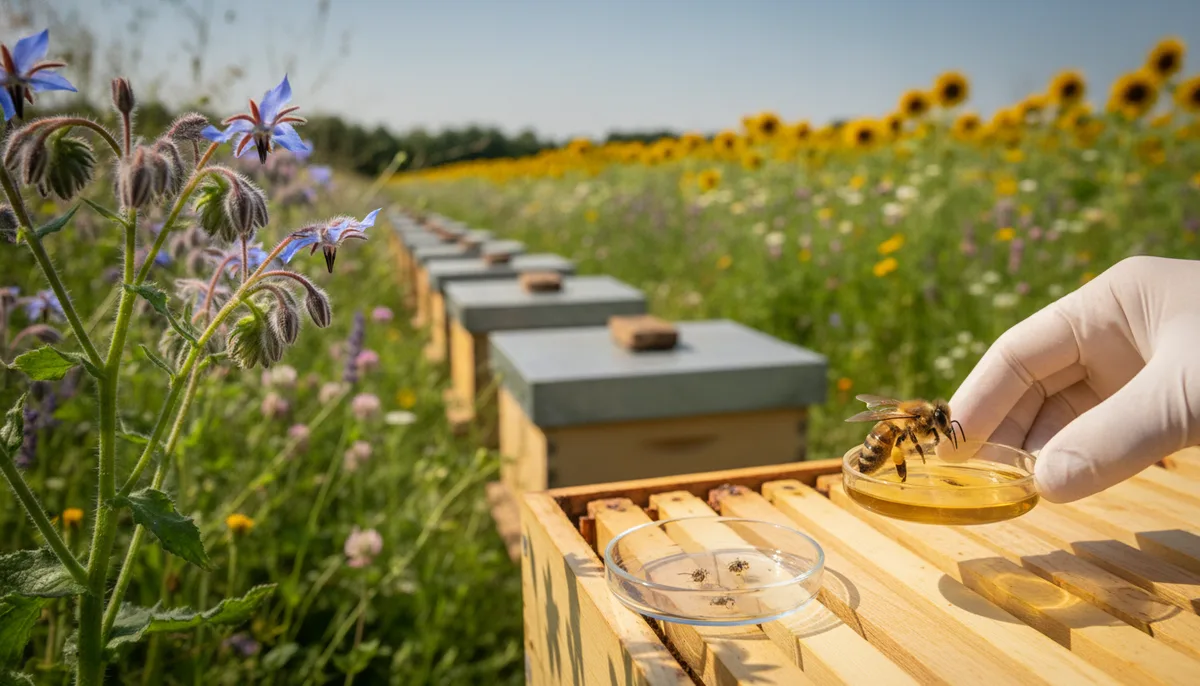
The most sustainable way to improve bee nutrition is through the landscape. Diversity is the key. Planting a variety of native wildflowers ensures that bees have a "buffet" of lipid profiles to choose from. Plants like canola, sunflowers (for Omega-6), and certain clovers provide different fatty acid signatures that allow the hive to self-regulate its nutritional intake.
Conclusion: A New Paradigm for Hive Health
The emerging science of bee lipids reminds us that honey bees are more than just the sum of the honey they produce. They are intricate organisms that require a balanced "molecular toolbox" to survive the modern world.
By ensuring our bees have access to essential polyunsaturated fatty acids, we aren't just feeding them; we are arming them. We are giving them the cognitive tools to navigate a changing landscape and the physiological strength to survive the chemical challenges of modern agriculture. As beekeepers, shifting our focus from "just enough food" to "the right kind of fat" may be the most important management decision we make this season.