
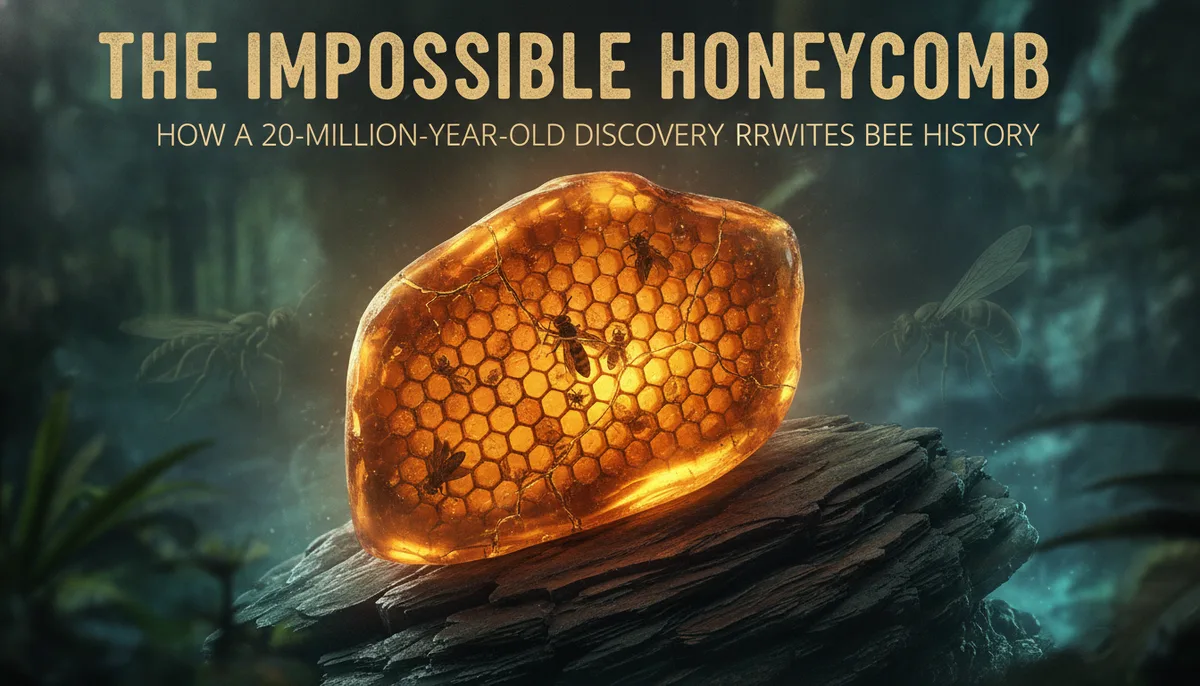
The Impossible Honeycomb: How a 20-Million-Year-Old Discovery Rewrites Bee History
A Geological Miracle in Buena Vista
For decades, the scientific community operated under a firm assumption: while individual insects could be perfectly preserved in tree resin, the complex, fragile architecture of a social beehive was simply too delicate to survive the fossilization process. That consensus has been shattered. In Buena Vista, Dominican Republic, a specimen of Dominican amber has emerged that contains something paleontologists once labeled "impossible"—an intact, 15-to-20-million-year-old honeycomb.
Documented by Hermann Dittrich of NaturalAmber.com, this find is not merely a curiosity; it is a profound leap forward in our understanding of the Miocene epoch. The specimen captures a moment in time where the resin of the now-extinct Hymenaea protera tree flowed over a section of a stingless bee colony, encased it, and hardened into amber, protecting the delicate wax structures from the ravages of millions of years.
This discovery provides a physical bridge between the ancient world and modern apiculture. To appreciate the complexity of these ancient structures, modern enthusiasts often look to Best Beginner Beekeeping Kits of 2024: Start Your Backyard Apiary with Confidence to see how today's equipment mirrors or departs from the natural designs of the past.
The Science of Dominican Amber Preservation
Dominican amber is world-renowned for its clarity and the high frequency of inclusions. Unlike Baltic amber, which is often cloudy, Dominican amber allows for a near-microscopic view of the organisms trapped within. This clarity was essential for corroborating the authenticity of the honeycomb structure.
The process of "amberization" or polymerization transforms sticky resin into a semi-precious stone. For a honeycomb to be preserved, several "impossible" conditions had to be met:
- Low Temperature Flow: The resin had to be cool enough not to immediately melt the delicate beeswax.
- Rapid Encasement: The flow had to be swift enough to surround the three-dimensional architecture before it collapsed under its own weight or was destroyed by the elements.
- Structural Integrity: The hive section had to be small enough to fit within a single resin discharge yet large enough to show the distinct hexagonal or pot-like cells characteristic of stingless bees.
Rewriting the History of Social Bees
The bees responsible for this "impossible" fossil are stingless bees (subtribe Meliponina). These are not the honeybees (Apis mellifera) most common in North America today, but rather their social cousins who have inhabited tropical regions for tens of millions of years.
Before this discovery, much of what we knew about ancient bee behavior was inferred from the morphology of isolated bees found in amber. We could see their pollen baskets and mouthparts, but we couldn't see their homes. This specimen changes that. It confirms that the social organization and architectural instincts of these bees were already highly advanced 20 million years ago.
The stability of bee architecture over millions of years is a testament to the efficiency of their design. When we look at the history of human intervention in beekeeping, such as in 1877: The Year That Defined Modern Beekeeping Equipment, we see humans finally catching up to the spatial efficiency that bees mastered in the Miocene.
The Trapped Scavengers: A Miocene Ecosystem
Perhaps the most scientifically significant aspect of the Dittrich specimen is not just the honeycomb itself, but the "trapped scavengers" found within the wax and resin.
Every modern beekeeper knows that a hive is its own ecosystem. From varroa mites to wax moths, a colony attracts a variety of guests—some symbiotic, some parasitic. The presence of scavengers in this 20-million-year-old amber reveals:
- Ancient Parasitism: The types of beetles or mites that were already specialized to live off the labor of stingless bees.
- Environmental Context: The specific climate and biological pressures present in the Buena Vista region during the Miocene.
- Behavioral Snapshots: How these scavengers moved and interacted with the hive before being immortalized in resin.
This level of ecological detail is why fossil research is so vital. It reminds us that the challenges facing bees today are part of a much longer evolutionary struggle. Understanding this history is why modern research facilities are so critical—a topic explored deeply in the discussion on The Beltsville Crisis: Why Losing Federal Bee Research Threatens the Future of American Beekeeping.
Why This Matters to Modern Beekeepers
It is easy to view paleontology as a field distant from the daily chores of an apiary, but the "Impossible Fossil" offers several practical insights for the modern steward of bees.
1. The Durability of Design
The hexagonal structure (or the specialized pots of the Meliponines) is a geometric masterpiece. Seeing it preserved for 20 million years reinforces the idea that bees have found an "evolutionary peak" in their nesting habits. As beekeepers, our goal is often to provide an environment that respects these millions of years of instinct.
2. Resilience and Vulnerability
While the honeycomb design is ancient and resilient, the bees themselves are susceptible to environmental shifts. The fact that the Hymenaea protera trees and the specific ancient bee species in this amber are now extinct serves as a sobering reminder of the fragility of even the most successful biological lineages.
3. The Value of Observation
Hermann Dittrich’s discovery was made possible by a keen eye for detail. In an era of high-tech beekeeping, the most valuable tool remains the ability to observe and recognize the unusual.
Conclusion: A Legacy in Resin
The 15-to-20-million-year-old honeycomb found in Dominican amber is more than just a beautiful artifact; it is a scientific breakthrough that challenges our understanding of fossilization and bee evolution. It proves that the "impossible" can happen, provided the conditions are exactly right.
As we continue to study this specimen, we gain a deeper appreciation for the stingless bees that once buzzed through the tropical forests of the Dominican Republic. They left behind a blueprint of their lives, encased in gold, to be found millions of years later by those who share their fascination with the world of the hive.
For those inspired by this ancient history to start their own journey into beekeeping, remember that you are participating in a tradition that spans millions of years. Whether you are setting up your first hive or studying the fossils of the past, you are a witness to one of nature's most enduring success stories.