
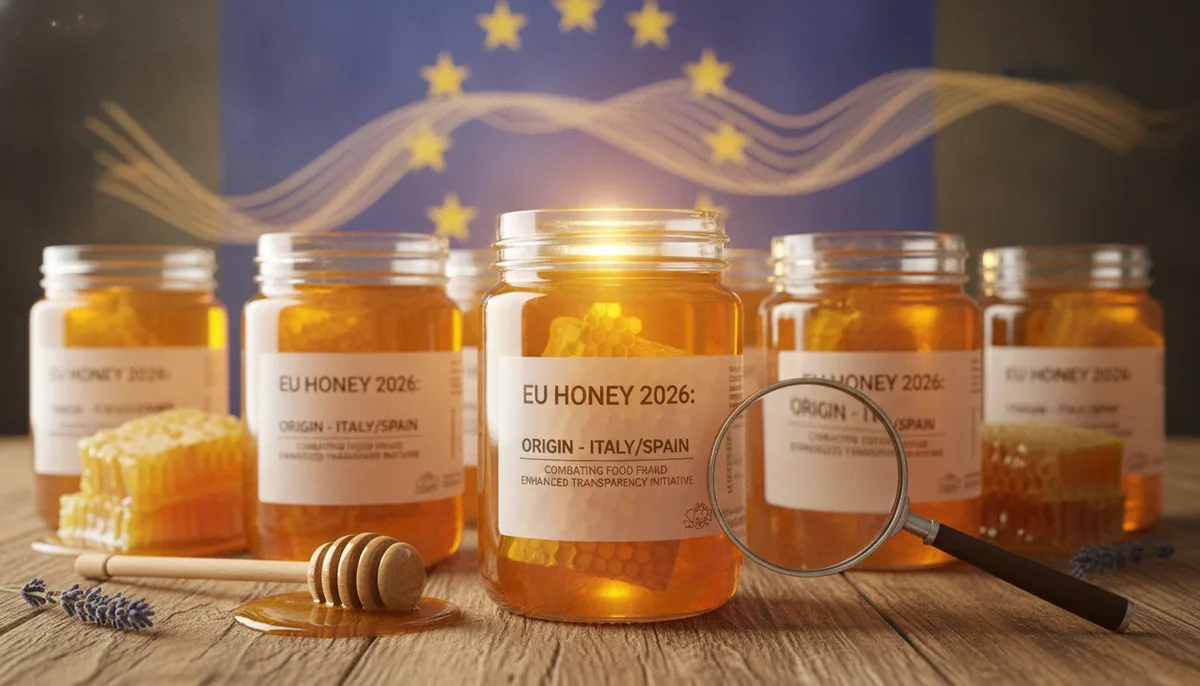
New EU Honey Labeling Rules 2026: A Deep Dive into Transparency and the Fight Against Food Fraud
For decades, the honey industry has operated under a cloud of ambiguity. Consumers walking down a grocery aisle and picking up a jar of honey were often met with a frustratingly vague label: "A blend of EU and non-EU honeys." This catch-all phrase provided almost zero insight into the product's actual origin, potentially masking a mix of high-quality local honey with ultra-processed, cheap imports from across the globe.
However, a massive shift in food transparency is on the horizon. On June 14, 2026, the European Union will officially implement the new Rules on the Quality and Labeling of Honey. This legislative update, which transposes Directive (EU) 2024/1438, represents one of the most significant victories for the beekeeping community in recent history. By mandating precise origin labeling, the EU is taking a stand against food fraud and empowering consumers to make informed choices.
The End of "EU and Non-EU" Vague Labels
Under the current regulatory framework, honey packers have been allowed to use generic geographical descriptors. This lack of specificity has long been a loophole exploited by large-scale distributors to blend expensive, high-quality European honey with cheaper alternatives without disclosing the proportions.
Starting in mid-2026, this practice ends. The new directive requires that every country of origin in a honey blend must be listed on the label. Furthermore, these countries must be listed in descending order of their weight, accompanied by the exact percentage that each country contributes to the final product.
Why Percentages Matter
The move to include percentages is the "teeth" of this new regulation. It prevents a scenario where a jar labeled "French and Chinese Honey" contains 99% imported syrup-based honey and only 1% local French honey. By seeing the percentages, consumers can finally understand the value proposition of the product they are buying.
For the hobbyist or small-scale professional, this level of transparency is a welcome change. If you are currently processing your own harvest, ensuring your product stands out against these transparently labeled commercial blends will be key. Utilizing high-quality equipment, such as those found in our guide to the best honey extractors for small scale harvests, ensures your local honey maintains the premium quality that consumers will now be looking for more than ever.
Combating Honey Fraud and Adulteration
Honey is consistently ranked as one of the most adulterated food products in the world, trailing only behind olive oil and milk. "Honey fraud" typically involves the addition of cheap sugar syrups (from corn, cane, or rice) to increase volume, or the use of "honey" that has been harvested too early and artificially dried—a process that destroys many of the beneficial enzymes and pollens.
The new EU directive isn't just about the label; it’s about the integrity of the supply chain. By requiring a clear paper trail for every percentage point of a blend, the EU makes it significantly harder for fraudulent honey to enter the market undetected.
The Role of Traceability
Traceability is the foundation of food safety. When a packer must declare that a jar contains 20% honey from Country A and 80% from Country B, they become legally responsible for the veracity of that claim. This puts pressure on importers to perform more rigorous testing and vetting of their suppliers.
A Historic Win for European Beekeepers
The European beekeeping sector has been under immense economic pressure for years. Local beekeepers, who adhere to strict EU environmental and animal welfare standards, often find it impossible to compete with the rock-bottom prices of imported honey blends that utilize the "EU/Non-EU" loophole.
This legislative change is being hailed as a "historic win" because it levels the playing field. When the origin and composition of honey are transparent, local beekeepers can better market the unique floral profiles and ethical standards of their harvests.
Economic Impact on the Apiary
By removing the "mask" of the generic blend, the market value of pure, single-origin honey is expected to stabilize. Consumers who value local pollination and biodiversity are more likely to pay a fair price when they can clearly see that the alternative "cheap" honey is a cocktail of origins they may wish to avoid.
For those in the United States, this EU victory serves as a roadmap and a warning. While the US has its own labeling challenges, the loss of research infrastructure, as discussed in our look at the Beltsville Crisis, highlights how critical federal and international support is for the survival of the beekeeping industry.
What Consumers Need to Know: Reading the New Labels
As we approach the 2026 deadline, consumers should prepare for a different look on the back of their honey jars. Here is what to look for once the rules take effect:
- The Full List: No more "EU/Non-EU." Expect to see a list of countries (e.g., Spain, Romania, Ukraine, Argentina).
- The Percentage Breakdown: Beside each country, a percentage (e.g., Spain 60%, Romania 40%).
- Descending Order: The country providing the most honey must be listed first.
This transparency allows consumers to support specific regions or avoid honey from countries with questionable environmental or labor practices. It also allows for better allergen management, as different geographical regions produce different pollen profiles.
The Global Ripple Effect
While Directive (EU) 2024/1438 is a European law, its impact will be felt globally. The EU is one of the world's largest importers of honey. Any country wishing to export honey to the European market will now have to provide the granular data required for this labeling.
This could lead to a global standard shift. If major exporters like China, Vietnam, or Brazil are forced to provide detailed origin and percentage data for the EU market, it becomes much easier for other nations (like the US or Canada) to demand the same level of transparency.
Preparing for June 2026: Advice for Beekeepers and Packers
If you are a beekeeper who sells honey, or if you operate a small packing business, 2026 will be here sooner than it seems. Preparation is key to staying compliant and competitive.
For Small-Scale Beekeepers
If you are selling 100% local honey, your labeling is already superior to the upcoming requirements. However, you should use this opportunity to highlight your "Single Origin" status. Make it clear that your honey doesn't just meet the new standards—it exceeds them by being 100% sourced from your specific apiary.
For Honey Packers and Blenders
If you do blend honeys from different sources, you must begin auditing your supply chain now.
- Verify Your Sources: Ensure your suppliers can provide the exact weight-based data you will need for your labels.
- Update Your Design: Your label real estate will need to accommodate the new list of countries and percentages.
- Test for Purity: To protect your brand, invest in independent testing to ensure the honey you are blending hasn't been adulterated before it reached you.
Conclusion: A Future of Honest Honey
The implementation of the Rules on the Quality and Labeling of Honey on June 14, 2026, marks the end of an era of "mystery honey." It is a significant step toward a food system that values honesty, supports the hard work of beekeepers, and respects the consumer's right to know what they are putting on their table.
As the industry moves toward this new standard, the focus shifts back to the bees and the environment. By ensuring that honey is a transparent, pure product, we protect not just a commodity, but a vital part of our global ecosystem. Whether you are a consumer looking for quality or a beekeeper looking for a fair market, the 2026 directive is a beacon of progress in the fight for food integrity.