
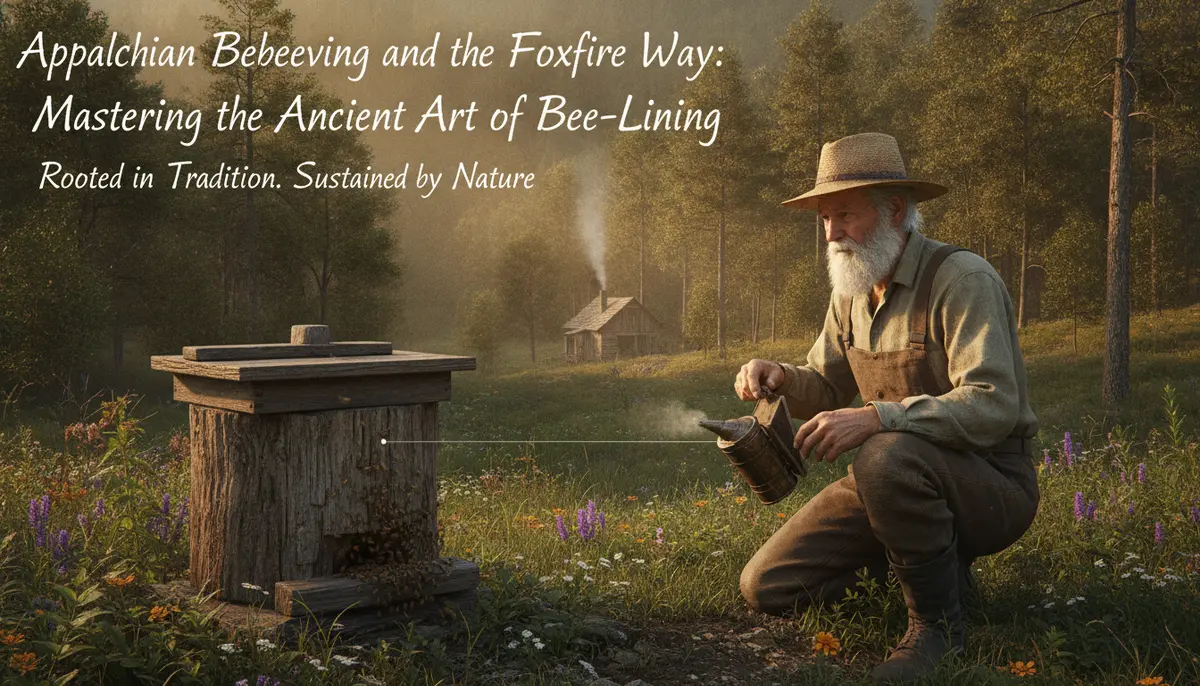
Appalachian Beekeeping and the Foxfire Way: Mastering the Ancient Art of Bee-Lining
The misty ridges of the Appalachian Mountains have long held secrets of self-reliance, passed down through generations of families who lived in harmony with the dense, flowering forests. Among these traditions, few are as captivating or as vital to the homestead as the "Foxfire" way of beekeeping. Long before commercial packages and plastic foundations were the norm, mountain families relied on their wits and the natural behavior of the honey bee to stock their apiaries.
Central to this heritage is the practice of bee-lining—a method of tracking wild bees back to their source. By understanding the environment and the biology of the bee, these early beekeepers were able to secure "free bees" and wild honey, housing them in rustic structures known as bee gums.
The Rich Flora of the Appalachian Forest
To understand why beekeeping flourished in Appalachia, one must first look at the landscape. The region is home to some of the most diverse temperate forests in the world. For a honey bee, this is a land of plenty. From the early spring blooms of the red maple and serviceberry to the late-summer bounty of sourwood and aster, the mountains provide a continuous "honey flow."
Appalachian families recognized that the wild bees they found in these forests were uniquely adapted to the local climate. These "wild" bees were often the descendants of European honey bees that had escaped managed hives and survived for decades in the hollows of ancient trees. Finding these colonies wasn't just about the honey; it was about capturing hardy, local genetics that could withstand the damp winters and unpredictable springs of the mountain range.
The Art and Science of Bee-Lining
Bee-lining is an exercise in patience, observation, and geometry. The premise is simple: a foraging bee will always take the most direct route back to its hive once it has filled its honey stomach. By creating a "line" of flight, a hunter can pinpoint the exact location of a wild colony.
Setting the Bait
The process begins by finding a foraging bee on a wildflower. The hunter uses a small, often handmade, wooden box—a bee-lining box—to capture the bee. Inside the box is a small honeycomb or a sponge soaked in heavy sugar syrup (scented with a drop of anise or lemongrass oil to make it more attractive).
Establishing the Line
Once the bee has fed, the hunter opens the box and watches closely. The bee will typically perform a few orientation loops before "making a bee-line" toward its home. The hunter marks this direction carefully.
The real magic happens when the bee returns. Honey bees are social creatures; once they find a rich food source, they go back to the hive and perform a waggle dance to recruit their sisters. Within thirty minutes, a single bee can turn into a dozen. By observing the flight paths of multiple bees, the "line" becomes undeniable.
Calculating the Distance
Appalachian beekeepers used the "timing" method to estimate distance. They would mark a single bee with a tiny dot of flour or paint and time how long it took for her to fly to the hive, unload, and return to the bait.
- A round trip of 2–4 minutes usually meant the hive was within 500 yards.
- A trip of 8–10 minutes suggested the hive was a mile or more away.
As the hunter moves the bait box further along the established line, the "line" is refined until the humming of the wild colony can be heard within a hollow tree.
From Forest to Farm: The Use of Bee Gums
Once a wild colony was located, the next challenge was bringing it home. In the tradition of the Foxfire books—which documented the vanishing folklore of Southern Appalachia—the standard housing for these bees was the "bee gum."
The name "gum" comes from the black gum tree (Nyssa sylvatica). These trees are prone to heart-rot, which creates a hollow center while the outer sapwood remains alive and sturdy. A section of a hollow gum tree would be cut, capped with a piece of board or stone, and used as a hive.
While bee gums were free and effective at insulating bees against the cold, they had a major drawback: they were "fixed-comb" hives. To harvest honey, the beekeeper often had to destroy the comb, and sometimes the colony itself. Today, while we admire the ingenuity of the bee gum, modern beekeepers have transitioned to more sustainable methods. If you are just starting your journey, Navigating the First Year: A Comprehensive Guide to Transitioning from Neophyte to Confident Beekeeper provides the necessary framework for moving from historical curiosity to modern best practices.
Modern Application: Why Bee-Lining Still Matters
You might wonder why anyone would bother bee-lining in an age where you can order a package of bees online with a few clicks. The answer lies in the quality of the bees and the thrill of the hunt.
- Locally Adapted Genetics: Wild colonies that have survived in the woods without human intervention often possess natural resistance to pests and diseases. Tracking these colonies allows a beekeeper to capture "survivor" stock.
- Environmental Awareness: Bee-lining forces you to slow down and observe the environment. You learn which flowers are blooming, how wind patterns affect flight, and where water sources are located.
- The Joy of Discovery: There is a profound sense of accomplishment in finding a wild hive hidden thirty feet up in a tulip poplar. It connects the modern beekeeper to the lineage of those Appalachian families who did the same a century ago.
If you're interested in attempting this, you'll need more than just a box. Ensuring you have the right protective gear and basic supplies is essential before heading into the woods. Check out our list of Essential Beekeeping Tools Every Newbie Needs: Beyond the Hive and Suit to prepare for your first expedition.
Transitioning Wild Bees to Modern Hives
If you successfully track a colony to a fallen log or a low-hanging branch, the goal is often to relocate them into a manageable hive. In the old days, this meant "robbing" the gum. Today, we use "trap-outs" or "cut-outs" to move the bees into a Langstroth hive.
Langstroth hive kit with frames
A "cut-out" involves carefully removing the wild comb and rubber-banding it into standard frames. This allows the bees to keep their brood and food stores while giving the beekeeper the ability to inspect the colony for health issues—something that was impossible with the old bee gums. This transition is a bridge between the Foxfire tradition and modern stewardship, ensuring the bees thrive for years to end rather than just one season.
Conclusion: Preserving the Foxfire Spirit
The Appalachian tradition of beekeeping wasn't just about honey; it was about a deep, intuitive understanding of the natural world. By following foraging bees back to their nests, families were able to tap into a free, renewable resource that provided both food and pollination for their gardens.
While we have better tools today—extractors that don't destroy comb and hives that allow for medical treatments—the core of the Foxfire way remains relevant. It encourages us to look closer at the "rich local forests," to respect the resilience of the wild honey bee, and to remember that the best lessons in beekeeping often come from the bees themselves. Whether you are a seasoned pro or a neophyte, there is much to be gained by occasionally leaving the apiary, heading into the woods, and looking for that first bee-line.