
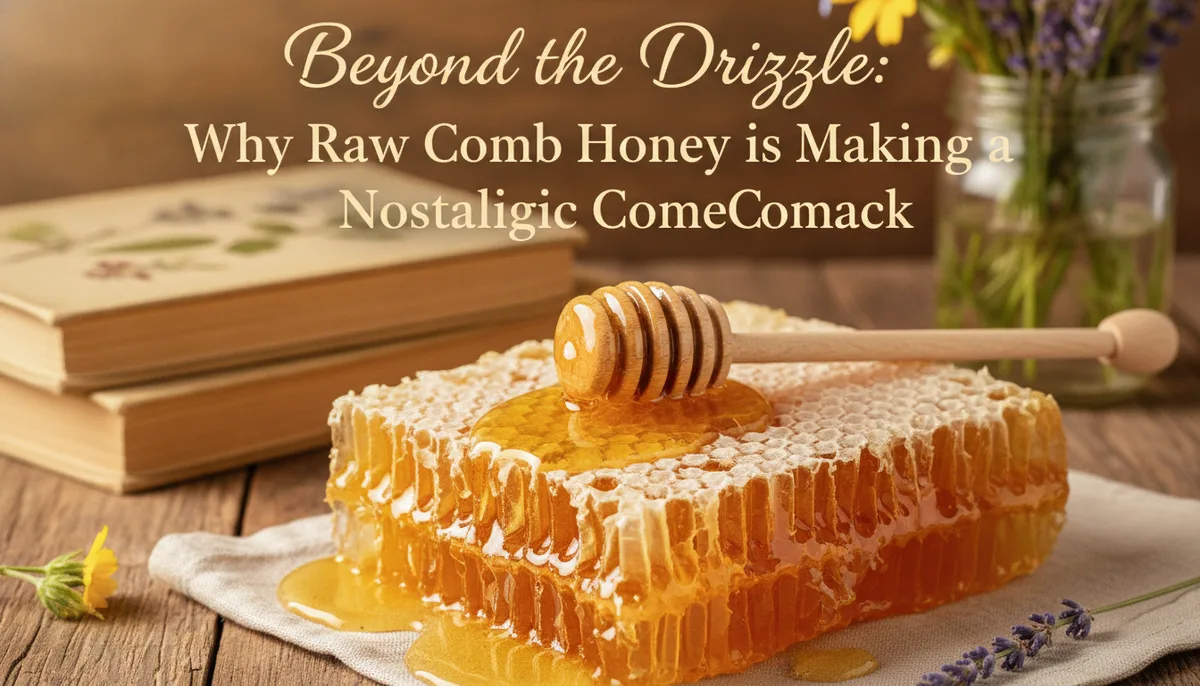
Beyond the Drizzle: Why Raw Comb Honey is Making a Nostalgic Comeback
The Sensory Return to the Nostalgic Kitchen
Close your eyes and imagine a kitchen from fifty years ago. There is no high-speed blender humming on the counter, and the air isn't filled with the sterile scent of microwave popcorn. Instead, there is the sharp, carbonized aroma of slightly burnt toast—the kind made in a manual toaster or over a woodstove—and the heavy, floral perfume of wax.
In this kitchen, honey didn't come in a plastic squeeze bottle shaped like a bear. It came in a heavy, wooden-framed square or a glass jar filled with thick, amber liquid and a substantial chunk of the hive itself. This was comb honey, the "gold standard" of the pantry. For decades, it was pushed aside by the convenience of clear, filtered liquid honey. However, we are currently witnessing a massive resurgence in the popularity of comb honey. It is a movement driven by a desire for authenticity, a connection to the "slow food" philosophy, and a craving for the complex textures that a simple drizzle cannot provide.
The Lost Art of the Honeycomb
To understand why comb honey is making a comeback, we must first understand why it left. The mid-20th century brought a wave of industrialization to beekeeping. The invention of the centrifugal extractor allowed beekeepers to spin the honey out of the wax frames, return the empty wax to the bees, and bottle a uniform, clear product. This was efficient. It was "clean." It was easy to ship.
But in that efficiency, something was lost. When honey is extracted, heated, and filtered, it loses the volatile aromatic compounds that give it a specific "sense of place." It also loses the texture. Comb honey is honey in its most raw, unadulterated state. It is sealed by the bees with a thin layer of wax cappings, preserving the moisture content and the delicate floral notes exactly as the hive intended.
Today’s consumers are moving away from the "uniform" and toward the "unique." Much like the rise of sourdough bread or craft coffee, the return to comb honey is a rejection of the mass-produced in favor of something that feels—and tastes—alive.
The Culinary Experience: Texture, Toast, and Tradition
The most striking thing about eating comb honey is the texture. When you bite into a piece of honeycomb, there is a distinct "crunch" or "snap" as the wax cells give way, releasing a burst of liquid honey that is often thicker and more flavorful than the bottled variety.
The Burnt Toast Connection
There is a reason the memory of comb honey is so often tied to burnt toast. The bitterness of the charred bread provides the perfect foil for the intense sweetness of the honey. When a slab of comb honey is pressed onto hot, buttered toast, the wax doesn't melt, but it softens. It creates a chewy, satisfying mouthfeel that lingers, allowing you to savor the floral notes of the nectar long after the honey has been swallowed.
Beyond the Breakfast Table
Modern chefs have rediscovered honeycomb as a powerhouse ingredient for charcuterie boards and desserts.
- Pairing with Cheese: The wax provides a structural element that pairs beautifully with creamy bries, sharp cheddars, or pungent blue cheeses.
- Textural Garnish: A small cube of honeycomb atop a panna cotta or a bowl of Greek yogurt transforms a simple dish into a gourmet experience.
- The "Hive to Table" Aesthetic: Visually, nothing beats the geometric perfection of the hexagonal cells. It serves as a reminder of the incredible engineering performed by the honeybee.
The Science of the Comb: Why the Wax Matters
It isn't just about the honey; it’s about the wax. Beeswax is a complex substance secreted by young worker bees. To produce just one pound of wax, bees must consume roughly six to eight pounds of honey. This makes the comb a precious commodity.
The wax in comb honey isn't just "packaging." It contains trace amounts of propolis (the "bee glue" used to disinfect the hive) and pollen. These elements add layers of flavor—sometimes earthy, sometimes spicy—that are absent from filtered honey. Furthermore, because the honey has never been exposed to the air or to the metal of an extractor, it hasn't undergone the oxidation that can dull the flavor of liquid honey.
For those interested in the deep history of these structures, exploring The Impossible Honeycomb: How a 20-Million-Year-Old Discovery Rewrites Bee History offers a fascinating look at how little the bees' engineering has changed over millions of years.
Producing Your Own: The Beekeeper’s Challenge
For the backyard beekeeper, producing comb honey is both a challenge and a reward. It requires a different management style than liquid honey production. Because you are asking the bees to build brand-new wax instead of reusing old frames, the colony must be exceptionally strong and the nectar flow must be heavy.
If you are just starting your journey into the world of bees, you might find that traditional liquid honey is easier for your first season. However, keeping a few sections aside for comb honey is a great way to connect with the heritage of the craft. To get started with the right equipment, you can check out the Best Beginner Beekeeping Kits of 2024: Start Your Backyard Apiary with Confidence to ensure you have the foundation needed for a healthy hive.
Tips for Successful Comb Honey:
- Crowd the Bees: Bees are often reluctant to build new wax in the small sections used for comb honey. Beekeepers often "crowd" the bees into a smaller space to encourage them to fill the comb sections quickly.
- Timing is Everything: You want the bees to fill and cap the comb during a fast, heavy flow (like clover or basswood) to ensure the wax is white and pristine.
- Minimal Handling: Once the comb is removed from the hive, it must be handled with care to avoid bruising the delicate cappings.
How to Choose and Store Comb Honey
If you aren't a beekeeper yourself, finding high-quality comb honey requires a bit of sleuthing. Look for "section honey," which is grown directly in a small wooden or plastic frame, or "cut comb honey," which is cut from a larger frame and placed into a jar.
What to Look For:
- Capping Color: Ideally, the wax cappings should be white or light ivory. "Travel-stained" wax (which is darker) is still delicious but indicates the comb stayed in the hive longer.
- Weight: A good section should feel heavy for its size, indicating the cells are fully filled.
- Purity: Ensure there are no "dry" cells or patches of uncapped honey, which can lead to fermentation if the moisture content is too high.
Storage Wisdom
Never put your comb honey in the refrigerator. Cold temperatures accelerate crystallization, turning the smooth liquid inside the cells into a gritty texture. Keep it in a cool, dark pantry. If it does crystallize, don't worry—it’s still edible and many people actually prefer the "crunch" of crystallized comb honey.
airtight glass honey jar with bamboo lid
Embracing the Slow Food Movement
The comeback of comb honey is more than just a food trend; it is a return to a sensory way of living. It encourages us to slow down, to chew our food, and to appreciate the immense labor of the natural world.
When you sit down with a piece of honeycomb and a slice of slightly over-toasted bread, you aren't just eating breakfast. You are participating in a tradition that spans centuries. You are smelling the woodsmoke and the beeswax of a bygone era, and you are bringing that richness into the modern day. Ditch the drizzle—the comb is where the true magic of the hive resides.